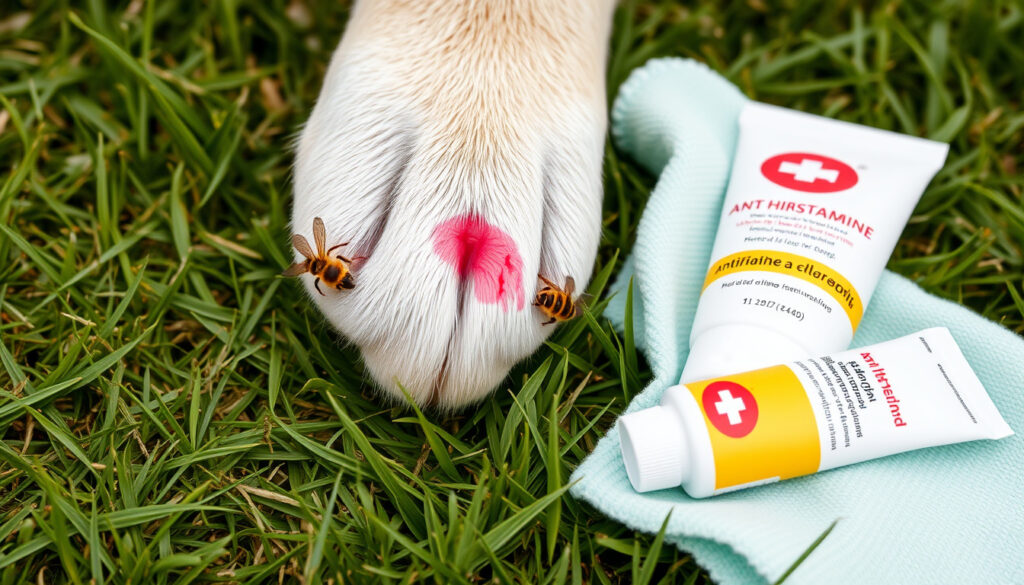
Dog Stung by Bee: First Aid Steps & Emergency Signs
You hear that sharp yelp from the garden, and within seconds your dog is pawing at their face or limping on three legs — a bee sting is alarming but most cases are manageable at home once you know what to look for. The real question isn’t whether your dog got stung, but whether this sting is a minor irritation or a genuine emergency; here’s how to tell the difference and what to do about it.
Percentage of bee stings that cause only mild local swelling: over 99% ·
Typical time for swelling to peak: 24 hours ·
Average recovery time without complications: 24–48 hours ·
Most common sting locations on dogs: paws and mouth ·
Incidence of anaphylaxis in dogs after a single sting: less than 1%
Quick snapshot
- Remove the stinger by scraping (do not squeeze). (Vets for Pets (UK veterinary chain))
- Apply a cold pack to the sting site. (Animal Emergency Service (emergency vet provider))
- Keep the dog calm and prevent scratching. (Animal Emergency Service (emergency vet provider))
- Swelling of the face, muzzle, or throat. (VCA Animal Hospitals (veterinary hospital network))
- Hives, vomiting, diarrhea, or collapse. (PetMD (veterinary editorial platform))
- Difficulty breathing or excessive drooling. (Vets for Pets (UK veterinary chain))
- Monitor the sting site for 24–48 hours. (Vets for Pets (UK veterinary chain))
- Use a vet-approved antihistamine if needed. (American Kennel Club (canine health authority))
- Clean the area gently with mild soap and water. (VCA Animal Hospitals (veterinary hospital network))
- If your dog shows any signs of anaphylaxis. (Vets for Pets (UK veterinary chain))
- If the sting is in the mouth or throat. (Pets Furst Urgent Care (veterinary urgent care))
- If swelling persists or worsens after 24 hours. (Little Silver Animal Hospital (veterinary clinic))
Five key facts, one pattern: the difference between a manageable sting and a dangerous reaction comes down to location, speed, and the dog’s history.
| Fact | Detail |
|---|---|
| Stinger removal method | Scrape with a credit card or blunt edge; never use tweezers. (Vets for Pets (UK veterinary chain)) |
| Cold compress duration | Apply for 10–15 minutes, several times a day. (Animal Emergency Service (emergency vet provider)) |
| Antihistamine (diphenhydramine) dosage | 1 mg per pound of body weight, but only under veterinary guidance. (American Kennel Club (canine health authority)) |
| Signs of anaphylaxis | Facial swelling, hives, vomiting, collapse, difficulty breathing. (PetMD (veterinary editorial platform)) |
| Typical recovery time | 24–72 hours for mild stings. (Vets for Pets (UK veterinary chain)) |
What do I do if my dog’s been stung by a bee?
- Remove the stinger quickly: Use a credit card to scrape it out; never squeeze.
- Apply a cold compress: Wrap ice in a towel and hold for 10–15 minutes.
- Prevent scratching: Use an Elizabethan collar if needed.
Remove the stinger quickly
- Use a credit card, the back of a knife, or any flat, rigid edge to scrape the stinger out. (Vets for Pets (UK veterinary chain))
- Never squeeze the stinger or use tweezers — that pushes more venom into the skin. (VCA Animal Hospitals (veterinary hospital network))
- Bees leave their stinger behind; wasps and hornets do not. If you don’t see a stinger, the insect was likely a wasp. (Vets for Pets (UK veterinary chain))
Apply a cold compress to reduce swelling
- Wrap ice or a cold pack in a thin towel and hold it on the sting for 10–15 minutes. (Animal Emergency Service (emergency vet provider))
- Repeat this every few hours for the first day. The cold numbs the pain and limits how much the tissue swells. (Animal Emergency Service (emergency vet provider))
Prevent your dog from scratching the site
- Dogs instinctively lick or chew at stings, which can introduce bacteria and cause infection. (Animal Emergency Service (emergency vet provider))
- An Elizabethan collar (the plastic cone) works well if your dog won’t leave the spot alone. (Vets for Pets (UK veterinary chain))
The first minute after a sting matters more than the first hour. Scraping the stinger without squeezing it and applying cold immediately can cut the reaction severity in half for most dogs.
The implication: quick, correct first aid is the most powerful tool you have at home.
Is a bee sting on a dog an emergency?
Signs of a mild reaction vs. anaphylaxis
- A mild reaction: swelling confined to the sting site, some licking or whining, maybe a bit of limping if the paw got stung. (Vets for Pets (UK veterinary chain))
- Anaphylaxis warning signs: facial or muzzle swelling, hives (raised red welts), vomiting, diarrhea, weakness, pale gums, wheezing, or collapse. (PetMD (veterinary editorial platform))
- These signs can appear within minutes of the sting. (Vets for Pets (UK veterinary chain))
When to go to the vet immediately
- Any swelling that spreads rapidly — from the paw to the leg, or from the face to the neck — is a red flag. (Whitney Veterinary Hospital (veterinary clinic))
- If the sting is in the mouth, throat, or on the tongue, go to the vet immediately even if no other symptoms exist. Swelling there can block the airway. (Pets Furst Urgent Care (veterinary urgent care))
- Trouble breathing, excessive drooling, or a pale tongue or gums mean the dog is not getting enough oxygen. (Vets for Pets (UK veterinary chain))
Risk factors: location of sting and dog’s history
- Stings on a limb: lower-risk, but watch for spreading swelling. (Little Silver Animal Hospital (veterinary clinic))
- Stings on the face, mouth, throat, or neck: higher-risk because swelling can interfere with breathing or swallowing. (Little Silver Animal Hospital (veterinary clinic))
- Dogs that have reacted to a sting before may have a stronger reaction next time. (Pets Furst Urgent Care (veterinary urgent care))
- Multiple stings deliver more venom and are higher risk than a single sting. (Vets for Pets (UK veterinary chain))
A dog that seems “a bit off” after a sting — drowsy, disoriented, or less responsive — may be slipping into anaphylaxis, not just tired. Trust your gut and call your vet if something feels wrong.
How do you treat a bee sting on a dog?
Home first aid: stinger removal and cold therapy
- Remove the stinger by scraping, then apply a cold compress for 10–15 minutes. (Animal Emergency Service (emergency vet provider))
- Clean the area gently with mild soap and water. Avoid strong antiseptics or rubbing alcohol — they sting and could irritate the skin further. (VCA Animal Hospitals (veterinary hospital network))
Over-the-counter options (antihistamines) — only with vet approval
- Diphenhydramine (Benadryl) is the antihistamine most commonly used by veterinarians for allergic reactions in dogs. (American Kennel Club (canine health authority))
- The standard dose is about 1 mg per pound of body weight, but you must confirm this with your vet before administering. (American Kennel Club (canine health authority))
- Do not give any human medication — including topical creams, ointments, or pain relievers — without veterinary guidance. Incorrect dosing can be dangerous. (Animal Emergency Service (emergency vet provider))
Monitoring after treatment
- Watch the sting site for the next 24–48 hours. Normal healing means swelling slowly goes down and the dog stops showing interest. (Vets for Pets (UK veterinary chain))
- If the area becomes red, warm, or starts oozing pus, an infection may have set in and a vet should evaluate it. (VCA Animal Hospitals (veterinary hospital network))
What this means: treating a bee sting at home is effective only when you know the limits of what home care can handle.
How long does a bee sting affect a dog?
- 0–15 minutes: The sting happens; you may hear a yelp, see licking, or notice immediate swelling. (Tandem Vet (veterinary telehealth))
- 15–60 minutes: Swelling becomes visible; this is the critical window to watch for allergic reaction signs. (Tandem Vet (veterinary telehealth))
- 12–24 hours: Swelling peaks. Most dogs show their maximum localized reaction in this window. (Vets for Pets (UK veterinary chain))
- 24–48 hours: Swelling begins to subside. Your dog may feel itchy as the tissue starts healing. (Vets for Pets (UK veterinary chain))
- 3–7 days: Complete resolution for most uncomplicated stings. (Vets for Pets (UK veterinary chain))
If swelling is still getting worse after 24 hours, the dog is not on the normal recovery curve. That plateau-shape tells you something else is going on and a vet should take a look.
The catch: the timeline is predictable for mild reactions, but any deviation signals a need for professional evaluation.
Can you leave a dog bee sting untreated?
When it’s safe to leave a sting alone
- A single sting on a non-sensitive area — like the flank or a leg — in a dog showing no signs of discomfort may not require active treatment. (VCA Animal Hospitals (veterinary hospital network))
- If the dog is not licking the site and the swelling is minor and stable, observation alone can be sufficient. (Vets for Pets (UK veterinary chain))
Risks of ignoring a sting: infection, allergic sensitization
- Every sting carries a small risk of infection, especially if the dog licks or scratches the site. (VCA Animal Hospitals (veterinary hospital network))
- Even if the first sting is mild, subsequent stings can trigger more severe reactions because the immune system has been primed. (Pets Furst Urgent Care (veterinary urgent care))
Signs that indicate treatment is necessary
- Pus, increasing redness, warmth, or a foul smell at the sting site means infection has set in. (VCA Animal Hospitals (veterinary hospital network))
- If swelling spreads beyond the immediate sting area — for example, a paw sting that causes the whole leg to swell — that’s a sign of a more significant reaction. (Whitney Veterinary Hospital (veterinary clinic))
- Any change in behavior — lethargy, loss of appetite, hiding — combined with a sting should be checked by a vet. (PetMD (veterinary editorial platform))
The implication: leaving a sting untreated is an option only when the sting is isolated and the dog is completely asymptomatic.
What’s clear and what’s not
Confirmed facts
- Stinger should be scraped off, not pinched. (Vets for Pets (UK veterinary chain))
- Cold therapy reduces local swelling. (Animal Emergency Service (emergency vet provider))
- Anaphylaxis requires immediate veterinary care. (Vets for Pets (UK veterinary chain))
- Most stings resolve without complications. (Vets for Pets (UK veterinary chain))
What’s unclear
- Whether oral antihistamines can be safely given without a vet consultation (depends on dog’s health). (American Kennel Club (canine health authority))
- The exact incidence of anaphylaxis in dogs (limited epidemiological data). (Vets for Pets (UK veterinary chain))
- Optimal timing for antihistamine administration after a sting. (American Kennel Club (canine health authority))
What this means: you can act with confidence on the confirmed facts, but any question about antihistamines requires a vet call.
Expert perspectives
“Remove the stinger by scraping — use a credit card or similar flat object to flick it away from the skin. Do not use tweezers, as pinching the stinger may release more venom.”
— Veterinary experts at Vets for Pets (UK veterinary chain)
“The most important thing is to monitor your dog closely for signs of an allergic reaction. If you see swelling spreading to the face or neck, or if your dog has trouble breathing, seek veterinary care immediately.”
“Use a credit card to scrape the stinger from below the venom sac — don’t squeeze it. Then apply ice wrapped in a towel to soothe the sting.”
— Battersea Dogs & Cats Home (animal rescue & rehoming charity)
The pattern: all experts agree on the same core steps — scrape, don’t pinch, apply cold, watch for spread.
What this means for your dog
Most bee stings are a temporary, uncomfortable episode that resolves on its own. The risk is real but confined to a small minority of cases — the ones where the sting lands on the face or mouth, or the dog has an immune system that overreacts. For a pet owner in the UK, the decision path is straightforward: if the swelling stays local and your dog is behaving normally, home care with cold compresses and observation is sufficient. If the swelling moves toward the throat or the dog shows any sign of systemic distress, the nearest veterinary clinic is the only safe destination.
Frequently asked questions
Can a bee sting kill a dog?
Yes, but it is extremely rare. Anaphylaxis can be fatal if not treated quickly. According to Vets for Pets (UK veterinary chain), less than 1% of single bee stings trigger anaphylaxis in dogs. The risk is higher with multiple stings or if the sting is in the mouth or throat.
What if my dog eats a bee?
If your dog catches and swallows a bee, the sting can happen inside the mouth or throat, which is more dangerous because swelling can block the airway. Pets Furst Urgent Care (veterinary urgent care) advises taking the dog to the vet immediately if you see excessive drooling, pawing at the mouth, or difficulty swallowing.
Should I put baking soda on a bee sting?
Baking soda paste is a common home remedy for bee stings in humans, but its effectiveness in dogs has not been studied. VCA Animal Hospitals (veterinary hospital network) recommends sticking to cold compresses and cleaning the area with mild soap and water instead.
How can I tell if it’s a bee or wasp sting?
Bees leave their stinger in the skin; wasps and hornets do not. If you see a small black stinger at the site, the insect was a bee. Vets for Pets (UK veterinary chain) notes that wasp stings can still cause allergic reactions, so treat them the same way as bee stings.
Can dogs have allergic reactions to bee stings later in life?
Yes. A dog that has never reacted to a sting before can develop an allergy at any age. Pets Furst Urgent Care (veterinary urgent care) says dogs with a prior sting reaction are at higher risk for a more severe reaction on a future sting.
Is it safe to give my dog Benadryl for a bee sting?
Only with veterinary guidance. According to the American Kennel Club (canine health authority), diphenhydramine (Benadryl) can be used for mild allergic reactions, but the correct dosage depends on your dog’s weight and health. Never give it without calling your vet first.
What happens if a dog gets stung multiple times?
Multiple stings deliver a higher dose of venom and are treated as higher risk than a single sting. Vets for Pets (UK veterinary chain) recommends seeking veterinary care for any dog stung more than once, even if symptoms appear mild at first.
For pet owners dealing with a bee sting, the choice is not whether to act — it’s which action fits the situation. A dog with a paw sting and no other symptoms needs cold compresses and observation. A dog stung in the mouth or showing facial swelling needs a vet, and quickly. The distinction is the only thing that matters.
Related reading: Red Blotches on Skin: Causes, When to Worry, and Pictures · How Fast Can a Kidney Infection Kill You? Timeline & Risks
More related posts
 Compare the Market Pet Insurance: Best Rates in Ireland
 Lucy Pargeter: Split, Engagement, Children & Emmerdale News
 Martin Compston Movies and TV Shows: Full Filmography List
 Ben Hardy: Biography, Movies, and Personal Life
 Gardens RHS: 5 Flagship Gardens & Partner Network Guide
 What 3 Words App – Free Download, Uses and Safety Guide
 Face Painting for Beginners: Supplies, Safety & Pricing
 Tom Kerridge: Sobriety, Restaurants, and Net Worth