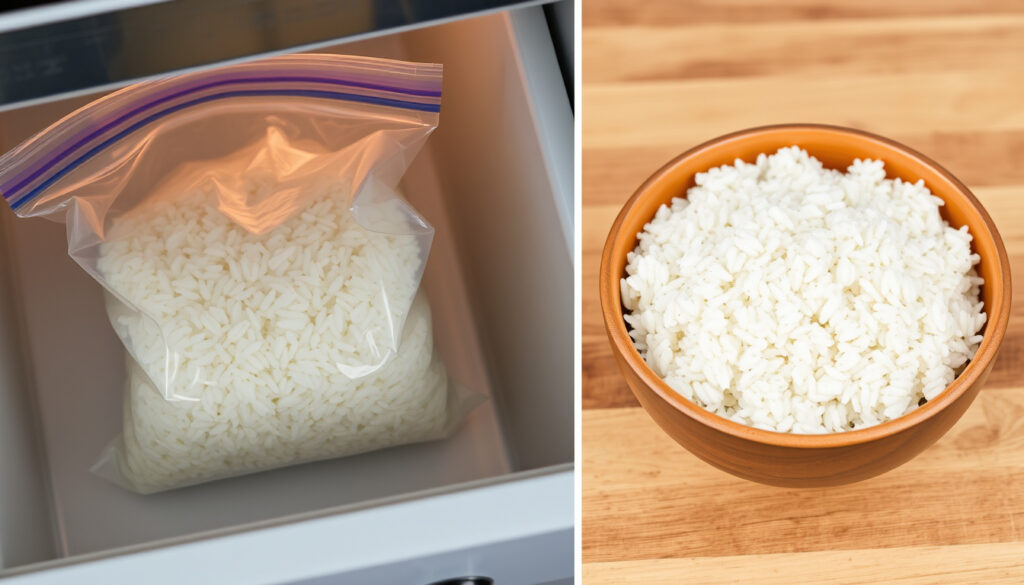
Can You Freeze Cooked Rice? How to Freeze & Reheat
We’ve all been there — you cook a big batch of rice and suddenly realize you made way too much. Throwing it out feels wasteful, but the thought of eating sad, gummy reheated rice the next day isn’t exactly appealing. The good news is that you can freeze cooked rice, and when done right, it freezes beautifully and reheats to a texture that’s genuinely enjoyable.
Fridge storage limit: 3-4 days ·
Freezer storage limit: 2-3 months ·
Cooling time before freezing: Under 2 hours ·
Safe reheat temp: 165°F
Quick snapshot
- Properly cooled rice freezes safely for 2-3 months (Good Life Eats)
- Reheat to 165°F for food safety (RiceSelect)
- Cooling to room temp prevents bacteria growth (Riceland)
- Exact taste variance depends heavily on rice variety
- How long freezer-burned rice remains palatable past 4 months
- Freeze same day or within 4 days in fridge
- Best quality within first 2 months
- After 2 months, rice may need extra water to restore texture
- Follow proper cooling steps before freezing
- Reheat directly from frozen — no thawing needed
- Use within 2-3 months for best results
These storage benchmarks give you the framework for deciding whether to freeze now or eat first.
| Attribute | Value |
|---|---|
| Safe to freeze? | Yes, after cooling to room temperature |
| Max freezer time | 2-3 months (optimal quality) |
| Fridge limit before freeze | 3-4 days |
| Cooling time (max) | Under 2 hours |
| Safe reheat temperature | 165°F |
| Texture fix | Spread to dry, pack tightly with minimal air |
Can you freeze cooked rice and reheat?
Yes — and it becomes one of the most reliable meal-prep shortcuts in your kitchen. Cooked rice freezes well when you handle it correctly, and you can reheat it straight from the freezer without any thawing step. The process takes about 10 minutes total, and the results work everything from quick weeknight dinners to meal-prepped lunches.
Safety concerns
The main safety concern with cooked rice isn’t the freezing itself — it’s what happens before you freeze it. Cooked rice can harbor Bacillus cereus bacteria, which produces toxins that survive both cooking and reheating. According to Riceland (rice producer and distributor), the key is cooling rice to room temperature within 2 hours before freezing. Don’t leave cooked rice out on the counter for more than 2 hours total.
Once frozen and reheated properly to 165°F, rice is just as safe as freshly cooked rice. Jersey Girl Cooks (home cooking blog) notes that reheating rice to a minimum internal temperature of 165°F eliminates any safety concerns.
Basic process
The freezing process itself is straightforward: cook rice until just tender (not overcooked), spread it on a baking sheet to cool quickly, then portion into freezer bags with as much air removed as possible. Label with the date, and freeze. Reheating is even simpler — you can go straight from frozen to hot rice in minutes using microwave, stovetop, or oven.
What you absolutely should not do is reheat rice more than once. Jersey Girl Cooks (home cooking blog) emphasizes this food safety rule: reheat only the portion you’ll eat, and never reheat leftovers twice.
The bacteria risk isn’t about the cold — it’s about the warm zone between 40°F and 140°F where bacteria multiply fastest. Quick cooling and fast freezing eliminate this window entirely.
Does rice get mushy if you freeze it?
Rice can become mushy after freezing, but this is entirely preventable. The culprit is almost always excess moisture — either you didn’t cool and dry the rice enough before freezing, or you packed it with too much air causing freezer burn. White rice, in particular, responds well to proper technique.
Causes of mushiness
The starch in rice is the main offender. When rice freezes, ice crystals form both between and within the starch granules. If there’s excess moisture on the surface or too much air in the bag, the rice absorbs more ice and the granules break down faster during reheating.
Good Life Eats (food preservation blog) specifically notes that overcooking rice before freezing compounds the problem — the grains soften even more during reheating, resulting in a mushy texture. Cook rice until just tender, then stop.
Prevention tips
Spread cooled rice on a baking sheet in a single layer for about 20 minutes before packing. This surface-drying step removes excess moisture without drying out the grains. Jersey Girl Cooks (home cooking blog) recommends pressing plastic wrap directly onto the rice surface in containers to prevent freezer burn.
Brown rice presents additional challenges. Good Life Eats (food preservation blog) notes that brown rice can dry out and become crumbly in the freezer because of its higher oil content. Cook brown rice until fully tender, and plan to add water or broth when reheating to restore moisture.
Freezer-burned rice remains safe to eat but loses significant quality. Good Life Eats (food preservation blog) recommends using freezer-burned rice in soups where the liquid will rehydrate the grains naturally.
How to freeze rice without it turning mushy
Following these steps consistently will give you frozen rice that reheats to a texture nearly indistinguishable from fresh.
Step-by-step freezing
- Cook rice until just tender — err on the slightly undercooked side since it will continue softening during reheating.
- Spread the hot rice onto a rimmed baking sheet in a thin, even layer. This cools the rice quickly and allows surface moisture to evaporate.
- Let the rice cool at room temperature for about 20 minutes. Don’t rush this step by putting hot rice in the fridge — the center of the portions will stay warm too long, creating the bacteria-friendly temperature zone.
- Portion the cooled rice into freezer bags or airtight containers. Jersey Girl Cooks (home cooking blog) recommends 1-2 cup servings, which are ideal for individual meals.
- Remove as much air as possible from bags before sealing.
- Label with the date and freeze immediately.
The implication is that skipping any of these steps directly increases your risk of mushy or freezer-burned rice.
Storage containers
Freezer bags work well for most home kitchens because you can flatten them to save space and easily squeeze out excess air. For containers, Good Life Eats (food preservation blog) suggests pressing plastic wrap directly against the rice surface before sealing the lid — this eliminates air pockets that cause freezer burn.
If you’re freezing rice with other foods like curry or vegetables, Good Life Eats (food preservation blog) recommends chopping mix-ins finely and freezing rice separately when possible. Aromatics in dishes like Mexican rice can change texture over time in the freezer.
Upsides
- Extends rice shelf life to 2-3 months
- Reduces food waste significantly
- Enables convenient meal prep
- Ready in minutes straight from freezer
- Works for plain and flavored rice varieties
Downsides
- Texture may differ slightly from fresh
- Requires proper cooling step upfront
- Brown rice prone to drying out
- Freezer burn after 2-3 months affects quality
- Must reheat only portion being eaten
How long can you freeze cooked rice?
Cooked rice keeps in the freezer for 2-3 months at optimal quality, though it remains safe indefinitely if kept at a constant 0°F. The practical limit isn’t food safety after that point — it’s texture. Rice stored beyond 2 months will progressively dry out and absorb more freezer odors.
Storage duration
Good Life Eats (food preservation blog) specifies that frozen cooked rice lasts 2-3 months in the freezer before risking freezer burn or drying out. The Takeout (food publication) extends this slightly to 3-4 months, noting that while rice remains safe beyond this window, you’ll want to add extra liquid when reheating older portions.
The takeaway: freeze rice when you’ll use it within 2 months for the best texture. After 2 months, add water or broth when reheating to restore moisture.
After 2-3 days in fridge
If you’ve kept cooked rice in the fridge for 2-3 days and haven’t used it, freezing is still a viable option — but it needs to go in the freezer immediately. The Takeout (food publication) notes that fridge-stored rice lasts 3-4 days total before quality drops significantly. Any longer than 4 days in the fridge and you should discard it rather than freeze.
The clock starts when the rice finishes cooking and begins cooling. If you refrigerate rice while it’s still quite hot, that 3-4 day window shrinks because the center of the rice mass hasn’t cooled quickly enough to prevent bacterial activity.
Rice stored past its prime in the fridge may smell slightly sour even before freezing. Trust your senses — sour-smelling rice should go in the trash, not the freezer.
Is cooked rice good after being frozen?
Yes — and in some ways, frozen and reheated rice can actually be better than day-old fridge rice. The quick-freeze process preserves the grains at their best, and controlled reheating with added moisture can yield fluffy results.
Taste after reheating
The taste and texture of reheated frozen rice depends heavily on your reheating method. RiceSelect (rice brand) rates the stovetop method highest for achieving fluffy texture: add 1-2 tablespoons of water per cup, cover, and steam over medium-low heat for the best results. This method mimics the steaming process that gives rice its characteristic texture.
The microwave works well for speed, producing edible but slightly firmer rice. The Takeout (food publication) suggests microwaving with 1-2 tablespoons of water per cup, covered with a damp towel, for 1-4 minutes depending on portion size.
Health considerations
Beyond convenience, there’s an interesting nutritional angle to cooling and reheating rice. When cooked rice is cooled and reheated, some of the starches undergo a process called retrogradation, which makes them more resistant to digestion. Good Life Eats (food preservation blog) notes this can result in a lower glycemic response compared to freshly cooked rice.
This matters for anyone managing blood sugar, though the effect varies based on rice type, cooling duration, and reheating method. The key is cooling the rice fully before reheating — the retrogradation process requires time at refrigerator temperatures.
You gain meal-prep convenience and potentially better glycemic behavior by freezing and reheating rice properly. What you trade off is the absolute freshest texture — but for most people, having rice ready in 5 minutes beats the marginal difference between fresh and frozen-and-reheated.
How to reheat frozen rice
You have several options for reheating frozen rice, and none of them require thawing first. The key across all methods is adding moisture and ensuring the rice reaches 165°F internally.
Microwave method
The microwave is the fastest option. RiceSelect (rice brand) recommends adding 1 tablespoon of water per cup of frozen rice, covering with a damp paper towel, and microwaving in 30-second increments until steaming hot. Total time is typically 1-2 minutes for a single cup, 3-4 minutes for larger portions.
Stovetop method
For the fluffiest results, the stovetop beats the microwave. RiceSelect (rice brand) calls this their favorite method: add 1-2 tablespoons of water per cup of frozen rice, cover, and heat over medium-low heat until done, then let steam off heat for 5 minutes with the lid on. This gentle steam-rest cycle restores the moisture and texture that microwaving can leave behind.
Oven method
The oven works well for large batches. RiceSelect (rice brand) specifies 300°F with 2 tablespoons of water per cup, covered tightly with foil, for 15-45 minutes until heated through to 165°F. This method is slower but keeps multiple portions evenly heated without hot spots.
Air fryer method
An air fryer gives surprisingly good results for a crispy-edge finish. RiceSelect (rice brand) recommends 350°F with 1 tablespoon of water per cup, covered with foil, for 5-10 minutes. This works best for rice that’s part of a dish like fried rice.
Rice cooker method
If you have a rice cooker, add 1 tablespoon of water per cup of frozen rice and use the regular cook setting. RiceSelect (rice brand) notes this automatically heats to the target temperature and gives consistent results with zero attention required.
What the experts say
“For rice that tastes as close to freshly made as possible, our favorite method is to reheat the rice gently on the stovetop.”
— RiceSelect (rice brand)
“Don’t leave it out for more than 2 hours for food safety.”
“Frozen rice that has freezer burn will still be safe to eat, but it would be better if used in soups.”
— Good Life Eats (food preservation blog)
Related reading: Can you freeze cooked rice? · How to freeze rice
Frequently asked questions
What is the 123 rice rule?
The “123 rule” refers to portioning: 1 cup of dry rice yields about 3 cups of cooked rice, which is roughly 2 adult servings. When freezing, this translates to 1-2 cup portions per freezer bag, which matches typical meal serving sizes for most people.
Why should you not freeze cooked rice?
There’s actually no food safety reason to avoid freezing cooked rice — it’s one of the most freezer-stable foods. The only legitimate reasons to skip freezing are if you prefer very fresh rice texture, or if the rice has already been in the fridge for more than 4 days, in which case it should be discarded rather than frozen.
Can you freeze cooked rice in a plastic container?
Yes, any freezer-safe plastic container works. Good Life Eats (food preservation blog) recommends pressing plastic wrap directly on the rice surface before sealing the lid to prevent freezer burn. Freezer bags are often preferred because you can flatten them to save space and remove air more easily.
Can you freeze cooked rice after 2 days?
Yes, if it’s been in the fridge the whole time and still smells fresh. Cooked rice keeps in the fridge for 3-4 days, so freezing it on day 2 is perfectly fine. Just ensure it cooled to room temperature quickly (within 2 hours) before going in the fridge, and freeze it immediately rather than waiting until day 4.
Can you freeze cooked rice with chicken?
You can, but for best results, freeze them separately when possible. Good Life Eats (food preservation blog) notes that mixed dishes freeze well together, but the rice component may become slightly softer while the protein stays fine. If freezing together, ensure the entire dish is frozen within 2 hours of cooking and use within 2-3 months.
Can you freeze cooked rice with curry?
Yes, rice and curry freeze together well in most cases. The curry’s liquid helps protect the rice from drying out. Good Life Eats (food preservation blog) suggests portioning into individual meal-sized containers and reheating directly from frozen. Rice-based curries freeze and reheat particularly well because the sauce rehydrates the grains.
More related posts
 Angela White biography: Adult star, activist, academic
 The Twilight Saga Movies – Correct Watch Order Guide
 Garden Sheds for Sale in Ireland: Planning & Deals
 The Great Pottery Throw Down: Watch, Cast, Seasons 2026
 Summer Clothes for Women – 2025 UK Trends Guide
 Paul Sun-Hyung Lee: Biography, Wife, Movies & TV Shows
 Charles Oliveira: Health, OnlyFans, Height, Losses & Religion
 BBC Weather Bury St Edmunds: 14-Day Forecast & Temperature