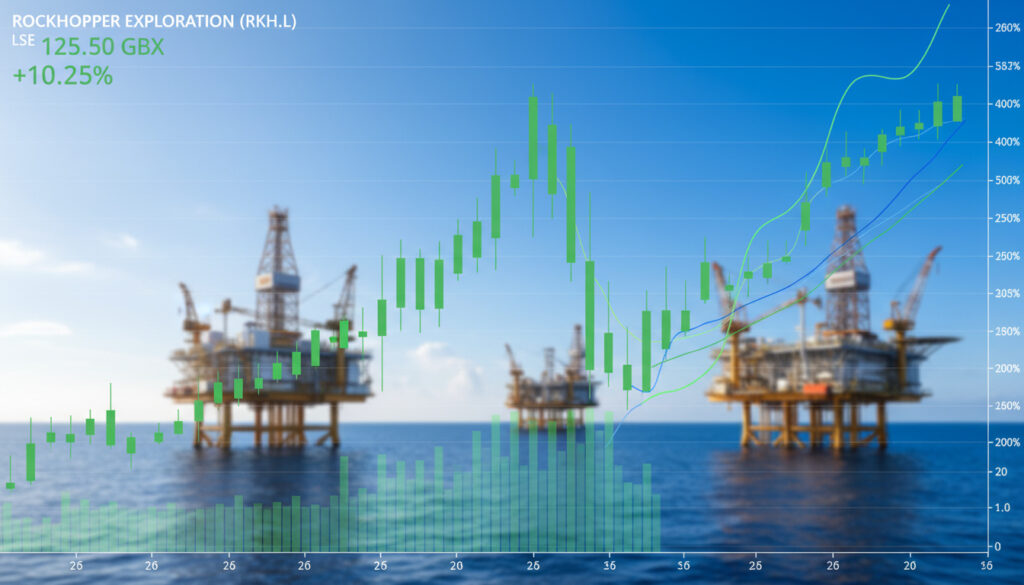
Rockhopper Exploration Share Price – Latest LSE Data and Analysis
Rockhopper Exploration plc (RKH.L) commands attention on the London Stock Exchange with a share price that has demonstrated extraordinary volatility throughout 2025. The oil and gas exploration company currently trades between 71.00 GBX and 74.80 GBX, reflecting the speculative nature of pre-production energy ventures focused on the Falkland Islands.
The stock has delivered a remarkable annual return exceeding 415%, climbing from lows near 12 GBX in October 2024 to recent levels around 73 GBX. This performance positions Rockhopper among the most active small-cap energy stocks on the LSE, drawing scrutiny from both retail investors and sector analysts monitoring developments in the South Atlantic.
As an exploration-stage company with no current revenue streams, Rockhopper’s valuation remains tethered to prospective resource estimates and the fluctuating probability of bringing its Sea Lion field into commercial production. Investors tracking the Royal Mail Price Finder for portfolio logistics will find equally dynamic pricing here, though driven by entirely different market forces.
What is the Current Rockhopper Exploration Share Price?
Key Insights on Rockhopper Exploration Shares:
- The stock trades under ticker RKH on the London Stock Exchange
- Beta of 1.15 indicates 15% higher volatility than the broader market
- Recent trading sessions saw volume spikes exceeding 6 million shares
- Share price remains 86% below its all-time high of 549 GBX reached in 2010
- Current valuation reflects speculative premium on Falklands oil prospects
- No dividend income is currently distributed to shareholders
- Net income of £37.26M contrasts with zero reported revenue, indicating non-operational income sources
| Metric | Value |
|---|---|
| Ticker | RKH.L |
| Exchange | London Stock Exchange |
| Sector | Oil & Gas Exploration |
| Market Cap | £470.14 million |
| Shares in Issue | 640.52 million |
| 52-Week Range | 12.03–89.27 GBX |
| P/E Ratio | 12.48–26.4x |
| Beta | 1.15 |
| Dividend Yield | 0.00% |
Recent Performance and Share Price History
The trajectory of Rockhopper’s share price over the past twelve months illustrates the high-risk, high-reward profile typical of frontier oil exploration equities. Data from TradingView indicates the stock has posted yearly gains of 415.86%, transforming it from a sub-15p penny stock into a mid-tier small-cap consideration.
52-Week Highs and Lows
The 52-week range spans from a low of 12.032 GBX recorded in late October 2024 to a recent peak of 89.265 GBX, according to eToro data. The London Stock Exchange confirms a narrower trading range of 12.55 GBX to 74.60 GBX, with the latter figure representing the session high on 28 July 2025. This discrepancy between platforms highlights the importance of checking multiple data sources when assessing entry points.
Historical Context
Rockhopper’s all-time high of 549.0 GBX, achieved on 24 September 2010, followed the confirmation of the Sea Lion discovery in the North Falkland Basin. Conversely, the nadir of 4.0 GBX in March 2020 reflected both broader market panic and specific concerns regarding the economic viability of Falklands development in a low oil price environment. Interactive charts tracking these movements are available via LiveCharts.
With a beta coefficient of 1.15 and intraday volatility measured at 4.41%, RKH shares exhibit significantly greater price swings than the FTSE All-Share index. Investors should anticipate continued fluctuation as the company advances funding discussions for the Sea Lion development.
Key Financial Metrics for Rockhopper Exploration (RKH)
Understanding Rockhopper’s financial structure requires distinguishing between traditional operating metrics and the unique accounting of exploration companies. While the firm reports zero revenue from oil sales—reflecting its pre-production status—it maintains a market capitalisation approaching £470 million based on resource potential.
Capital Structure and Valuation
The company has 640.52 million shares in circulation, with a free float of 581.33 million shares available for public trading. This substantial share count dilutes individual price movements but provides liquidity for institutional positioning. The price-to-book ratio stands at 1.7x, suggesting the market values the company above its accounting net worth but below speculative premiums seen in some exploration peers.
Profitability Metrics
Despite lacking revenue, Rockhopper reported net income of £37.26 million for the fiscal year, derived from arbitration awards and licence management activities rather than hydrocarbon extraction. Earnings per share (TTM) register at 5.88 GBX, creating a price-to-earnings multiple that varies between 12.48x and 26.4x depending on calculation methodology and data provider. Investing.com cites the lower figure, while LSE data suggests the higher multiple.
Rockhopper Exploration currently generates no revenue from oil and gas operations. The £37.26M net income derives from arbitration proceeds and licence management, not production. This accounting distinction fundamentally differentiates RKH from dividend-paying energy majors.
Latest News and Factors Impacting RKH Share Price
Recent trading activity suggests renewed institutional interest in the Falklands oil play. On 28 July 2025, LSE.co.uk recorded 6.3 million shares changing hands across 1,013 individual trades, with bought volume reaching 2.7 million shares valued at £1.84 million. This volume spike coincided with a 13.62% single-session advance.
Analyst Price Targets
Consensus estimates compiled by TradingView indicate a maximum analyst target of 102.94 GBX and a minimum of 68.34 GBX. Investing.com calculates upside potential at 6.3% from current levels, though these projections remain contingent upon securing development partners for the Sea Lion field. Analysts base these forecasts on oil price trends, sanctioning timelines, and the company’s ability to monetise its arbitration award.
Trading Venue and Accessibility
Rockhopper maintains its primary listing on the London Stock Exchange under the ticker RKH. The stock trades in the Main Market’s standard listing segment, offering settlement through CREST and eligibility for ISA and SIPP wrappers. Retail investors seeking high-street banking services to fund purchases might consult the NatWest Bank Near Me locator for branch availability.
Rockhopper Exploration does not currently distribute dividends. The company retains all capital for exploration activities and potential development of the Sea Lion field. Income-focused investors should note the 0.00% yield before allocating funds.
Rockhopper Exploration Share Price Timeline
Key events shaping RKH’s valuation since inception:
- : Initial Public Offering on AIM at approximately 40 GBX per share, raising capital for Falklands frontier exploration.
- : Sea Lion discovery announced; share price peaks at 549.0 GBX on 24 September as resource estimates exceed 300 million barrels.
- : Global market rout and oil price collapse drive shares to all-time low of 4.0 GBX on 23 March.
- : ICSID arbitration award of $100m+ against Argentina for expropriated licenses provides balance sheet strength and share price support.
- : Shares bottom at 12.55 GBX amidst funding uncertainty for Sea Lion development.
- : Volume surge to 6.3 million shares as price approaches 75 GBX, marking a 415% annual gain.
Share Price Certainty: Established Facts vs. Ongoing Uncertainties
| Established Information | Information That Remains Unclear |
|---|---|
| RKH trades on the LSE Main Market with ticker RKH.L | Final investment decision timeline for Sea Lion development |
| Market capitalisation is approximately £470 million | Exact barrel count in contingent resources versus reserves |
| Zero revenue from oil operations; £37.26M net income from arbitration/licences | Oil price assumptions used by Navitas Petroleum for farm-in economics |
| Beta of 1.15 confirms higher volatility than market average | Regulatory stability of Falkland Islands offshore licensing post-Brexit |
| 52-week range definitively spans 12.03 GBX to 89.27 GBX | Potential dilution from future equity raises to fund development |
What Drives Rockhopper Exploration’s Market Valuation?
Rockhopper’s share price functions as a leveraged bet on the commercialisation of the Sea Lion complex in the North Falkland Basin. Unlike integrated oil majors whose valuations reflect diversified production portfolios, this single-asset dependency creates binary risk dynamics. Successful sanctioning of the phased development project with partner Navitas Petroleum could validate resource estimates exceeding 400 million barrels of oil equivalent. Conversely, further delays in securing project finance or sustained weakness in Brent crude prices threaten the economic threshold required to justify subsea infrastructure investment.
The company’s 2022 arbitration victory against the Republic of Argentina provided temporary financial ballast, converting historical licence losses into cash reserves. However, long-term value creation necessitates transitioning from litigation-based income to hydrocarbon production revenue. This transition timeline remains the critical variable underlying current share price volatility.
Data Verification and Expert Sources
Regulatory filings and exchange data provide the evidentiary foundation for current valuations. The London Stock Exchange’s official company page serves as the primary venue for trade reporting and news dissemination, while TradingView aggregates real-time pricing and volatility metrics. Financial data providers including Investing.com and eToro offer comparative analysis tools, though investors should note discrepancies in P/E calculations between platforms.
Recent trade data indicates substantial institutional participation, with 2.7 million shares purchased in a single session representing £1.84 million in value traded.
— LSE.co.uk Trade Reporting, 28 July 2025
Outlook for Rockhopper Exploration Shares
Rockhopper Exploration presents a high-conviction, high-variance proposition for risk-tolerant investors. With shares trading near the middle of analyst target ranges and showing exceptional yearly momentum, the stock reflects market optimism regarding Sea Lion development progress. However, the absence of revenue, zero dividend yield, and dependency on external financing for field development demand careful position sizing. Those monitoring the Royal Mail Price Finder for stable income investments stand at the opposite spectrum from RKH’s speculative growth profile.
Frequently Asked Questions
How to buy Rockhopper Exploration shares?
Purchase through any UK broker offering LSE Main Market access. RKH is ISA-eligible and settles via CREST. International investors require brokers supporting London Stock Exchange trading.
What is the analyst target price for RKH?
Analysts set targets ranging from 68.34 GBX to 102.94 GBX, with consensus suggesting modest upside from current levels near 73 GBX.
Does Rockhopper Exploration pay dividends?
No. The company maintains a 0.00% dividend yield, reinvesting all capital into exploration and potential development activities.
What is Rockhopper Exploration’s beta?
The stock carries a one-year beta of 1.15, indicating 15% greater volatility than the broader UK equity market.
How many shares does Rockhopper have in issue?
640.52 million shares are issued, with 581.33 million available in the public float.
What was Rockhopper’s all-time high share price?
549.0 GBX, achieved on 24 September 2010 following the Sea Lion discovery announcement.
Where is Rockhopper Exploration headquartered?
The company operates from the UK with offshore exploration licences in the Falkland Islands.
What is the 52-week low for RKH shares?
Approximately 12.03 GBX, recorded in October 2024.
More related posts
 DWP 2025 Cost of Living Payment – No Payments Scheduled
 K-Pop Demon Hunters Cast: Speaking & Singing Voices
 Virgin Media Pay Bill – Quick No-Login Guide
 Kelly Cates Weight Loss 2025: Surgery Rumors & Podcast Facts
 Amazon UK Contact Number 0800 0345 Free Number – Verified Helplines
 Niamh McCormack: Irish Actress, Roles & Dublin Roots
 James Nelson-Joyce Wife – Olivia Brown Engagement Explained
 Ladies Coats in Ireland: Top Brands, Sales & Where to Buy