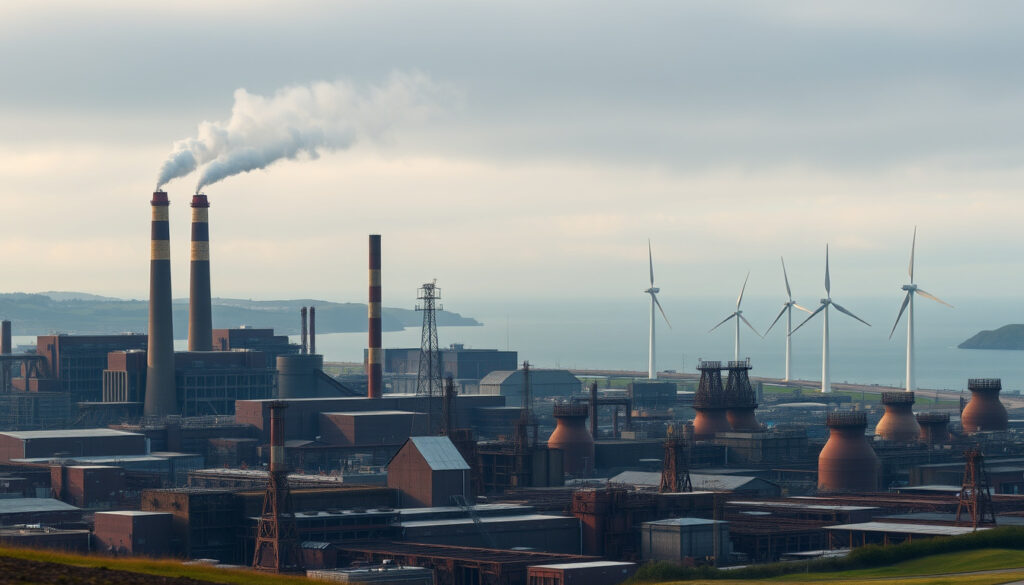
Tata Steel Port Talbot: News on Closure and Green Transition
For more than a century, the steelworks at Port Talbot shaped Welsh identity as surely as the furnaces shaped the steel. In September 2024, that era ended when workers tapped the last liquid iron from Blast Furnace 4, closing a chapter that spanned over 100 years of continuous operation. Tata Steel is now building an electric arc furnace at the site, betting £1.25 billion that green steel is the future—and the UK Government has put up £500 million to help make it happen.
Location: Port Talbot, Wales · Owner: Tata Steel UK · Status: Blast Furnace 4 closed; green steel transition underway · Size: Largest steelworks in UK · Future: Electric Arc Furnace by 2027
Quick snapshot
- Owned by Tata Steel UK, part of Tata Steel Europe
- Last iron tapped from Blast Furnace 4 on 30 September 2024 (Tata Steel UK YouTube)
- Electric arc furnace expected commissioning late 2027 or early 2028 (The Cool Down)
- Exact number of jobs lost post-September 2024 closure not publicly quantified
- Specific number of jobs the new EAF facility will create remains undetermined
- Full timeline for facility ramp-up to full production capacity uncertain
- September 2023: Investment agreement announced
- September 2023: Tata Steel confirms blast furnace closure plans
- 30 September 2024: Last iron tapped from Blast Furnace 4 (Investment agreement announced)
- September 2023: Tata Steel signs contract with Tenova for EAF installation
- February 2025: Planning permission granted (Investment agreement announced)
- February 2025: Groundbreaking ceremony (Investment agreement announced)
- Construction of electric arc furnace continues through 2025–2027
- New EAF expected to begin production by December 2027
- Transition Board supporting displaced workers and local businesses
Key operational and investment data for the Port Talbot steelworks transition is summarized below.
| Label | Value |
|---|---|
| Operator | Tata Steel UK |
| Location | Port Talbot, Neath Port Talbot, Wales |
| Capacity | Largest in UK |
| Status | Transitioning to green steel |
| Key Project | Electric Arc Furnace (2027) |
| Investment | £1.25 billion |
| Government Grant | £500 million |
| Emissions Reduction | 90% |
Is there still a steelworks in Port Talbot?
Steel production continues at Port Talbot, but the process has changed entirely. The traditional blast furnaces that defined Welsh steelmaking for generations fell silent in September 2024 when the last liquid iron was tapped from Blast Furnace 4 on 30 September 2024. Tata Steel is now constructing an electric arc furnace at the site, marking a fundamental shift in how steel will be made there.
The electric arc furnace uses high-current electricity to melt scrap steel, eliminating the need for coal and iron ore that blast furnaces required. This technology is central to Tata Steel’s plan to cut Scope 1 CO2 emissions by 90% after the transformation is complete. The new plant will source 75% of raw materials from the UK, replacing 7 million tonnes of imported iron and coal annually.
Current production status
Port Talbot is not idle. While the blast furnaces are retired, the site remains active as construction crews build the new electric arc furnace. Tata Steel UK’s Chief Commercial Officer Anil Jhanji confirmed the transition is progressing on schedule, with the groundbreaking ceremony having taken place in July 2025. Planning permission for the project was granted in February 2025, clearing the way for full-scale construction.
Recent changes
The changes extend beyond the technical. Tata Steel proposed voluntary redundancy to its workforce following union discussions, with the closure of blast furnaces cutting half of the plant’s jobs. A Transition Board was established to support people, businesses and communities affected by the change, chaired by Jo Stevens MP, Secretary of State for Wales. The UK Government has committed £500 million in grant funding as part of the £1.25 billion joint investment.
The shift to electric arc furnaces means the new plant will depend heavily on scrap steel supplies. Unions have raised concerns that this could make the UK dependent on imported scrap metal, potentially undermining the domestic supply chain benefits the transition promises. This vulnerability could reshape the UK’s steel supply dynamics in unexpected ways.
Who owns Tata Steel in Port Talbot?
Tata Steel UK operates the Port Talbot Steelworks, which is part of the broader Tata Steel Europe group ultimately owned by India’s Tata Group. The company is the sole operator of the facility following the closure of previous joint ventures. Tata Steel UK is headquartered in London, with its primary manufacturing operations concentrated in South Wales.
The Port Talbot operation is significant not just locally but nationally: it holds the distinction of being the UK’s largest single emitter of carbon dioxide, making the current transition a matter of both industrial and environmental consequence for the entire country.
Ownership structure
Tata Steel UK is a subsidiary of Tata Steel Europe, which in turn belongs to Tata Group, one of India’s largest conglomerates. The structure has evolved over decades of consolidation in the European steel industry. Tata Steel acquired the Corus Group in 2007, bringing the Port Talbot works under its current ownership umbrella.
Parent company details
Tata Steel has global operations across multiple continents, but the Port Talbot facility represents its most significant UK presence. The company committed to the £1.25 billion green steel investment in September 2023, with the UK Government providing £500 million in grant funding. The investment represents one of the largest industrial decarbonization projects in British history.
The joint investment structure means UK taxpayers are directly funding Port Talbot’s transformation. With £500 million in public money committed, the government has a financial stake in ensuring the transition succeeds—for jobs, for communities, and for the UK’s climate commitments.
The implications for UK industrial policy are significant: the Port Talbot case will likely shape how government approaches future decarbonization of heavy industry.
Is Tata Steel closing in Port Talbot?
Tata Steel is not closing Port Talbot—it is reinventing it. The blast furnaces are gone, yes, but construction of the replacement facility is already underway. The last iron was tapped from Blast Furnace 4 on 30 September 2024, and the blast furnaces and coke ovens were officially retired that same month. What is replacing them is the electric arc furnace, which is expected to be commissioned in late 2027 or early 2028.
Tata Steel’s Chief Commercial Officer Anil Jhanji confirmed the transition is progressing on schedule, with planning permission granted in February 2025 and groundbreaking ceremonies held in February 2025. The new facility is expected to begin production by December 2027.
Blast furnace closures
Two blast furnaces and the coke ovens at Port Talbot were retired in September 2024. The closure marked the end of an era: the steelworks had operated for more than 100 years before the blast furnace shutdown. Blast Furnace 4 had an operational life expected to extend until 2032 before the early closure decision was made, following union consultations held in January 2024.
Future operations
Steel production will continue under the new regime, but the process will be unrecognizable. The electric arc furnace will use electricity to melt recycled steel scrap rather than ore and coal. Tata Steel will on average halve the emissions of products it sells through this transformation. The new plant will replace 7 million tonnes of imported iron and coal with domestically sourced materials.
The pressure on the Transition Board to produce measurable outcomes for displaced workers will only intensify as construction progresses.
Why did Tata close Port Talbot blast furnaces?
Tata Steel closed Port Talbot’s blast furnaces because the old technology could not meet the demands of a decarbonizing economy. The blast furnaces made Port Talbot the UK’s largest single emitter of carbon dioxide, accounting for roughly 1.5% of the country’s total direct CO2 emissions. As UK climate policy tightened, and as European competitors moved toward greener production methods, continuing with coal-fired steelmaking became economically and politically untenable.
Tata Steel evaluated alternative proposals from unions but rejected them as not cost-effective. The company determined that the electric arc furnace route represented the most viable path forward, despite the significant job losses the transition would require.
Reasons for closure
The business case for traditional blast furnace steelmaking in the UK had deteriorated steadily. High energy costs, carbon pricing, and competition from overseas producers had squeezed margins. Tata Steel had reported financial difficulties in its European operations for years before announcing the transition. The UK Government’s £500 million grant made the electric arc furnace investment feasible, tipping the scales toward transformation rather than continued operation of the existing plant.
Environmental and economic factors
The environmental case was straightforward: Port Talbot’s blast furnaces generated enormous carbon emissions. The planned 90% reduction in Scope 1 CO2 emissions would represent a meaningful contribution to UK climate targets. The economic case was more complex. The transition would preserve steelmaking in the UK—a politically valued industry—but at the cost of thousands of traditional manufacturing jobs.
The agreement between Tata Steel and the UK Government represents one of the most significant industrial investments in Wales in a generation.
Just Transition Finance Lab briefing, analysis of the September 2023 investment agreement
Whether the new electric arc furnace can sustain steelmaking capacity at Port Talbot will depend on reliable electricity supply and competitive energy costs. EAFs are highly electricity-intensive, and industrial energy prices in the UK remain a competitive disadvantage compared to some European counterparts. This energy cost gap could undermine the green steel economics if not addressed.
The risk that electricity costs could derail the entire transition remains the industry’s most pressing concern.
Where is Tata Steel in Wales?
Tata Steel’s primary Welsh facility is the Port Talbot Steelworks, located on the M4 corridor in South Wales. The site sits within the Neath Port Talbot county, directly alongside the River Afan estuary. Its coastal location historically provided convenient access to imported raw materials, though the new operation will source 75% of inputs from UK suppliers.
Port Talbot is the largest of Tata Steel’s UK operations, which also include sites in Sheffield and Scunthorpe. The works have been central to the local economy for more than a century, though the recent transition means the facility’s footprint and workforce will be fundamentally different going forward.
Exact location
The Port Talbot Steelworks occupies a substantial coastal site near the town centre, adjacent to the Port Talbot railway station. The facility spans multiple square kilometres of industrial land, with the new electric arc furnace construction taking place within the existing footprint. Neath Port Talbot Council has established a Transition Board to coordinate support for affected workers and local businesses.
Site details
As the UK’s largest steelworks, Port Talbot includes multiple production buildings, raw material handling areas, and infrastructure connections. The closure of the blast furnaces has freed up sections of the site, which are being repurposed for the electric arc furnace installation. Tata Steel signed a contract with Tenova, an industrial equipment firm, in October 2024 for the EAF installation.
Blast Furnace 4 at Port Talbot had an expected operational life until 2032 before early closure. Its shutdown marks the end of a century of traditional steelmaking in South Wales.
Sky News, reporting on the September 2024 closure
For South Wales, the closure of Port Talbot’s blast furnaces signals the end of an industrial era that defined the region’s identity for over a century.
What remains uncertain about the Port Talbot transition?
Several aspects of the transition lack clear answers. The exact number of jobs lost in the September 2024 closure has not been publicly quantified in available sources, leaving uncertainty about the precise scale of workforce reduction. The number of positions the new electric arc furnace will ultimately create also remains undetermined, making it difficult to assess whether the new facility will employ hundreds or low thousands.
The full timeline for ramping up to full production capacity at the new EAF is not yet confirmed. While the commissioning is expected for late 2027 or early 2028, the path from first fire to full operational capacity could involve months of testing and calibration.
Confirmed facts
- Owned by Tata Steel UK, part of Tata Steel Europe
- Last iron tapped from Blast Furnace 4 on 30 September 2024
- Electric arc furnace construction underway
- £1.25 billion investment (Tata Steel + UK Government)
- £500 million UK Government grant confirmed
- Planning permission granted February 2025
- Groundbreaking ceremony held February 2025
- Transition Board established to support affected workers
Rumors and unknowns
- Exact workforce figures post-transition unconfirmed
- Production capacity of new EAF not publicly disclosed
- Future of Tata Steel’s other UK sites unclear
- Long-term energy supply arrangements for EAF operation
- Customer commitments for purchasing green steel output
Upsides
- 90% reduction in CO2 emissions
- New EAF uses UK-sourced scrap steel
- £1.25 billion investment in Welsh industry
- Planning approved and construction underway
- Transition Board provides worker support structure
Downsides
- Approximately 50% of workforce lost
- UK may become dependent on imported scrap
- Uncertainty around exact job creation numbers
- Electric arc furnace depends on reliable, affordable electricity
The gap between promised jobs and actual workforce needs will be the defining challenge for policymakers in South Wales over the next several years.
The implications of the Port Talbot transition extend beyond emissions numbers. Steelworkers approaching retirement face the most difficult choices: accepting voluntary redundancy with immediate financial support but uncertain future employment, or waiting to see what roles the new facility might offer. Younger workers have more runway but will need retraining to work with electric arc furnace technology.
For the broader UK steel industry, Port Talbot serves as a test case. If the transition succeeds—keeping steelmaking viable while dramatically cutting emissions—it could establish a model for other sites facing similar decarbonization pressures. If it fails, the political case for supporting high-carbon industry through green transitions will weaken considerably. The stakes for the industry extend well beyond this single Welsh facility.
Related reading: Forest Green Rovers F.C. – Players, Stadium, Tickets and Vegan Guide
Tata Steel’s Port Talbot steelworks completed blast furnace closures in 2024, with key updates on closure and green shift providing essential details on the ongoing green transition.
Frequently asked questions
What is Tata Steel Port Talbot?
Tata Steel Port Talbot is the UK’s largest steelworks, located in Port Talbot, South Wales. It is operated by Tata Steel UK and has been producing steel for over 100 years. The site is currently undergoing a major transformation from traditional blast furnace production to electric arc furnace technology as part of a green steel transition.
How many employees at Tata Steel Port Talbot?
The exact current workforce number is not publicly confirmed. Tata Steel proposed voluntary redundancy to its workforce, and the closure of blast furnaces cut approximately 50% of the plant’s jobs. The Transition Board was established to support affected workers, but precise headcount figures for before and after the transition are not available in public sources.
What is the contact number for Tata Steel Port Talbot?
Specific contact numbers for the Port Talbot site are not published in public sources. The Tata Steel UK main switchboard can provide general enquiries routing. For Transition Board support services, Neath Port Talbot Council maintains a dedicated information hub for affected workers and businesses.
Are there jobs at Tata Steel Port Talbot?
Yes, but significantly fewer than before. The blast furnace closures eliminated approximately half the workforce. Tata Steel is building an electric arc furnace expected to be commissioned in late 2027 or early 2028, but the exact number of positions the new facility will create has not been publicly disclosed.
What news from Tata Steel UK?
Major developments include the February 2025 closure of the last blast furnaces, planning permission granted in February 2025 for the electric arc furnace, a February 2025 groundbreaking ceremony, and ongoing construction toward an expected December 2027 production start. Tata Steel’s Chief Commercial Officer confirmed in mid-2025 that the transition remains on schedule.
Where is Port Talbot Steelworks located?
Port Talbot Steelworks is located in Port Talbot, Neath Port Talbot county, South Wales. The coastal site sits alongside the River Afan estuary, directly off the M4 motorway. It is the largest steelworks in the United Kingdom by output capacity.
Is Tata Steel Wales expanding?
Tata Steel is reducing its Welsh workforce through the blast furnace closure but investing heavily in new technology at Port Talbot. The company is constructing an electric arc furnace that will fundamentally change production methods, though this represents modernization rather than expansion of capacity. The long-term production volumes of the new facility have not been publicly confirmed.
More related posts
 Manchester United Ruben Amorim – Record, Tenure and Exit
 Zack Snyder’s Justice League Guide: Differences & Runtime
 Bleeding from Anus No Pain: Causes, Treatment & When to Worry
 Man City vs Tottenham Lineups: Predicted XIs and Match Preview
 The Phoenician Scheme Showtimes in Ireland – ODEON & Streaming
 Monica Dolan: Biography, Partner, Roles, and Awards
 Rockhopper Exploration Share Price – Latest LSE Data and Analysis
 Jackie Jackson 2025: Net Worth, Family, Twins & Life Now