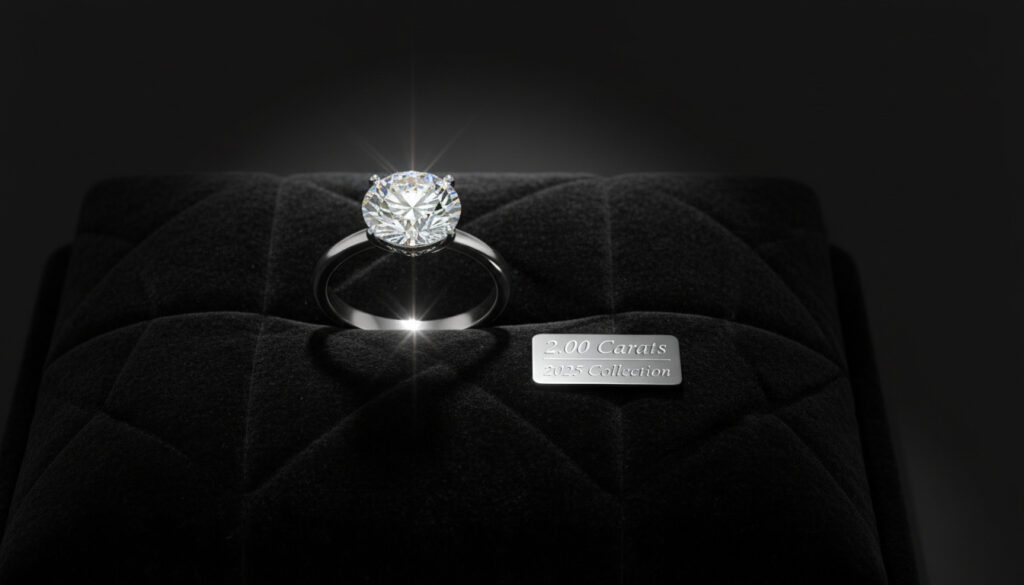
2 Carat Diamond Ring – 2025 Cost and Size Guide
A 2 carat diamond ring represents a significant milestone in fine jewelry, balancing impressive visual presence with wearable practicality. As market dynamics shift rapidly between natural and laboratory-grown stones, understanding current pricing structures and quality indicators has become essential for prospective buyers in 2025.
Recent data indicates that lab-grown options now command substantial market share, with prices ranging from $2,000 to $7,000 for complete rings, while natural diamonds maintain premium positioning between $20,000 and $130,000 for high-quality specimens. This divergence reflects broader changes in consumer priorities, with ethical sourcing and value retention competing as primary decision factors alongside traditional measures of rarity and prestige.
This guide examines the factual landscape of 2 carat diamond acquisition, analyzing cost determinants, visual characteristics, and certification standards without promotional bias. Every figure and recommendation draws from current gemological research and market reports to support informed purchasing decisions.
How Much Does a 2 Carat Diamond Ring Cost?
Lab-Grown Entry Point
Starting at $2,000 for the stone alone, with complete rings averaging $3,000–$7,000 depending on setting quality.
Natural Diamond Premium
High-quality natural stones command $20,000 to $130,000+, with significant variance by shape and color grade.
Shape Price Variance
Oval natural diamonds average $129,809 compared to $28,009 for rounds, while lab-grown ovals sit at $6,039.
Market Trend
Lab-grown prices have dropped 80–90% below natural equivalents since 2020, democratizing access to larger stones.
- Value Divergence: Lab-grown diamonds cost 80–90% less than natural stones of equivalent quality according to Diamonds Pro.
- Cut Priority: Cut quality determines sparkle more significantly than exact carat weight or minor clarity variations.
- Certification Necessity: GIA or IGI certification is non-negotiable for verifying claimed specifications and preventing fraudulent sales.
- Shape Premiums: Fancy shapes like oval and pear carry substantial premiums in natural categories compared to rounds.
- Benchmark Standards: Industry pricing uses 14kt gold settings as the standard reference point for cost comparisons.
- Market Volatility: Annual price fluctuations of 10–20% reflect volatile supply chains and shifting consumer demand.
- Statement Threshold: The 2 carat weight marks the entry into “statement” jewelry territory, with 2.00–2.24ct ranges showing fastest growth.
| Specification | Ideal Standard | Price Impact |
|---|---|---|
| Diamond Type | Lab-grown vs Natural | 80-90% cost reduction for lab |
| Carat Weight | 2.00 ct | Baseline pricing tier |
| Color Grade | G or better (natural) | D-F premium adds ~20% |
| Clarity Grade | VS2 or higher | Ensures eye-clean appearance |
| Cut Quality | Excellent/Ideal | Critical for light performance |
| Shape | Round vs Oval (natural) | Oval commands 4x premium over round |
| Certification | GIA or IGI | Prevents valuation disputes |
| Setting Metal | 14kt Gold | Industry pricing benchmark |
Is a 2 Carat Diamond Ring Big?
Physical Dimensions and Weight
A 2 carat diamond weighs approximately as much as half a raisin, yet its visual impact varies dramatically based on cut dimensions. Face-up measurements differ significantly by shape: round brilliant cuts typically measure 8.10 × 8.10 mm, while oval cuts extend to 10.50 × 7.00 mm, and pear shapes reach 11.0 × 7.00 mm according to Diamonds Pro.
Proportions and Hand Size Compatibility
Elongated shapes such as oval and pear create the illusion of greater size on smaller fingers, particularly sizes 4 through 6, while round brilliant cuts provide balanced symmetry for larger hand sizes. Halo settings can amplify perceived dimensions beyond the stone’s actual measurements, effectively increasing visual presence without additional carat weight.
For maximum perceived size on smaller hands, elongated shapes like oval or pear offer greater surface area than round cuts of equivalent carat weight. Pairing these with halo settings further amplifies the visual footprint without increasing carat cost.
Natural vs Lab-Grown 2 Carat Diamond: Key Differences
Chemical Composition and Cost Structure
Laboratory-grown diamonds are chemically and optically identical to natural stones, yet command prices 80–90% lower, with quality specimens available under $7,000 total. Natural diamonds maintain higher resale values and rarity premiums, though they carry potentially greater environmental impact and reveal inclusions more readily at the 2 carat scale according to With Clarity.
Certification Standards
For natural stones, the Gemological Institute of America (GIA) provides the most rigorous grading standards. Laboratory-grown diamonds typically receive certification from the International Gemological Institute (IGI), which offers reliable assessment at lower cost points. Both certifications verify the 4Cs, treatments, and origin to prevent fraudulent claims as noted by Varniya.
Uncertified 2 carat diamonds carry significant valuation risk. Insist on GIA documentation for natural stones and IGI reports for lab-grown to verify authenticity and prevent treatments or simulants passing as genuine diamonds.
Best Shapes and Styles for a 2 Carat Diamond Ring
Shape Performance Characteristics
Round brilliant cuts maximize light return and fire, dominating the market for sparkle intensity. Oval cuts offer elongated, feminine aesthetics that visually lengthen fingers. Princess, cushion, pear, and emerald cuts provide alternative geometries, though fancy shapes generally command higher per-carat prices when budgets are constrained according to Diamonds Pro.
Engagement Ring Suitability
The 2 carat weight has transitioned from luxury tier to mainstream acceptance in 2025, with particular growth in the 2.00–2.24 carat range. Contemporary settings favor halo, solitaire, three-stone, and pavé configurations, with platinum and white gold dominating modern preferences while yellow gold provides vintage warmth as reported by Natural Diamonds Council.
While round brilliant cuts offer optimal light performance, elongated fancy shapes like oval and pear can appear larger than their carat weight suggests. However, natural fancy shapes often carry significant premiums over rounds, making lab-grown alternatives more practical for budget-conscious buyers seeking distinctive geometries.
How to Buy a Quality 2 Carat Diamond Ring
Prioritizing the 4Cs
Cut quality demands primary attention, as excellent or ideal grades maximize light reflection regardless of size. For natural diamonds, color grades of G or better prevent yellow tinting in solitaire settings, while VS2 clarity or higher ensures eye-clean appearance without visible inclusions. Carat weight serves as the final consideration after these quality benchmarks are met, since a 1.9ct excellent cut outperforms a 2.1ct poor cut in visual appeal.
Verification Protocols
High-resolution imagery and 360-degree video inspection confirm eye-clean status beyond grading reports. Ethical sourcing requires Kimberley Process certification for natural stones, while lab-grown alternatives offer inherent conflict-free status with full traceability. Settings should be customized to hand dimensions to optimize the stone’s visual impact according to Diamonds by Rothschild.
Technical purchasing decisions require careful comparison methodology, similar to evaluating performance specifications in Asics Running Shoes Women – Best 2025 Picks and Fit Guide, where fit and function determine long-term satisfaction.
Diamond Price Trends 2020–2025
- : Post-pandemic recovery drove average natural diamond prices to approximately $15,000 for quality 2 carat stones, with supply chain constraints beginning to emerge.
- : Continued supply disruptions maintained elevated pricing tiers for natural diamonds while laboratory production scaled significantly across Asian markets.
- : Lab-grown diamonds achieved parity in chemical certification standards, with IGI reports gaining widespread acceptance among major retailers.
- : Market share for lab-grown stones expanded beyond 50% of consumer purchases, forcing price corrections in natural stone inventories.
- : Lab-grown 2 carat diamonds now start under $2,000 for loose stones, while the 2.00–2.24 carat range has become the fastest-growing segment for engagement rings according to Messi Gems.
Established Facts vs. Uncertain Market Dynamics
| Established Information | Information Requiring Further Clarity |
|---|---|
| Laboratory-grown diamonds are chemically identical to natural stones | Long-term resale value stability for lab-grown diamonds remains unproven beyond 5-year windows |
| Cut quality determines brilliance more than carat precision | Exact timeline for natural diamond price stabilization following lab-market disruption |
| Prices fluctuate 10–20% annually based on global supply chains | Environmental impact comparisons vary significantly by mining location versus production facility energy sources |
| VS2 clarity ensures eye-clean appearance in 2 carat stones | Consumer perception shifts regarding “forever” value associated with natural rarity |
| GIA and IGI provide reliable certification standards | Potential regulatory changes affecting lab-grown diamond disclosure requirements |
Understanding the 4Cs and Market Position
The evaluation of 2 carat diamonds rests on the interplay of cut, clarity, color, and carat weight, with cut serving as the primary determinant of visual performance. Excellent or ideal cut grades maximize light reflection and fire, rendering poor cuts immediately apparent even to untrained observers regardless of stone size. Clarity requirements intensify at the 2 carat threshold, where inclusions become more visible to the naked eye, necessitating VS2 grades or higher for eye-clean assurance.
Color grading assumes heightened importance in solitaire settings without adjacent stones to mask tint. While D through F grades command premium pricing, G color offers near-colorless appearance at significant cost savings. The market context in 2025 reflects a bifurcated landscape where laboratory-grown stones have democratized access to larger carat weights, while natural diamonds maintain cachet in heirloom and investment contexts. This shift has redirected consumer focus from pure rarity metrics toward ethical provenance and cut precision as primary value indicators.
Expert Perspectives on Diamond Quality
Cut is king. The precision of a diamond’s facets determines its ability to return light to the eye, making excellent cut grades non-negotiable for maximizing brilliance in 2 carat stones.
— GIA Gemological Expert, Whiteflash Education
The 2 carat diamond has transitioned from a luxury milestone to a mainstream expectation, particularly as laboratory-grown alternatives provide accessible entry points without compromising chemical integrity.
— Industry Analysis, Angara Gemological Research
Final Recommendations for Buyers
Prospective purchasers should prioritize cut quality above all other factors, selecting excellent or ideal grades to ensure optimal light performance. For natural diamonds, insist on GIA certification with minimum G color and VS2 clarity specifications, while lab-grown purchases require IGI documentation to verify specifications. Current market conditions favor lab-grown stones for value-conscious buyers seeking maximum visual impact, whereas natural diamonds remain preferable for those prioritizing long-term heirloom value. When selecting from available inventory, compare technical specifications as rigorously as one would when researching iPhone 15 Pro Max Price – Best Deals Starting at $463 to ensure optimal feature-to-cost ratios.
Frequently Asked Questions
Is a 2 carat diamond appropriate for an engagement ring?
Yes, 2 carat diamonds have become mainstream for engagements in 2025, offering substantial presence without excessive impracticality. The size balances visual impact with daily wearability across various settings and hand sizes.
What certification should I prioritize for a 2 carat diamond?
Natural diamonds require GIA certification for comprehensive grading accuracy, while lab-grown stones should carry IGI documentation. Both verify the 4Cs, origin, and any treatments applied to the stone.
Where should I purchase a 2 carat diamond ring?
Reputable online retailers with high-resolution imaging and 360-degree video capabilities allow detailed inspection before purchase. Ensure vendors provide independent laboratory certification and transparent return policies regardless of physical or digital storefront.
Do lab-grown 2 carat diamonds look identical to natural ones?
Yes, laboratory-grown diamonds are chemically, physically, and optically identical to natural stones. Gemological equipment is required to distinguish between them, making visual comparison impossible without specialized tools.
What is the resale value of a 2 carat diamond ring?
Natural diamonds typically retain 20-60% of retail value depending on market conditions and quality, while lab-grown diamonds currently hold minimal resale value. Purchase primarily for enjoyment rather than investment potential.
More related posts
 British Gas Emergency Number – UK Free 24/7 Helpline Guide
 When Is Traitors On – Full UK BBC Schedule Guide
 Anyone But You Cast: Full List, Ages, and Background (2023)
 What Are the 10 Commandments – Full List, Verses and Differences
 Why Is My Tongue White – Causes, Treatments & Prevention
 Madeleine McCann 2026: Latest DNA evidence & updates
 Post Office Closing Time: An Post Hours Ireland Guide
 300 USD to GBP: How to Convert Dollars to Pounds in 2025