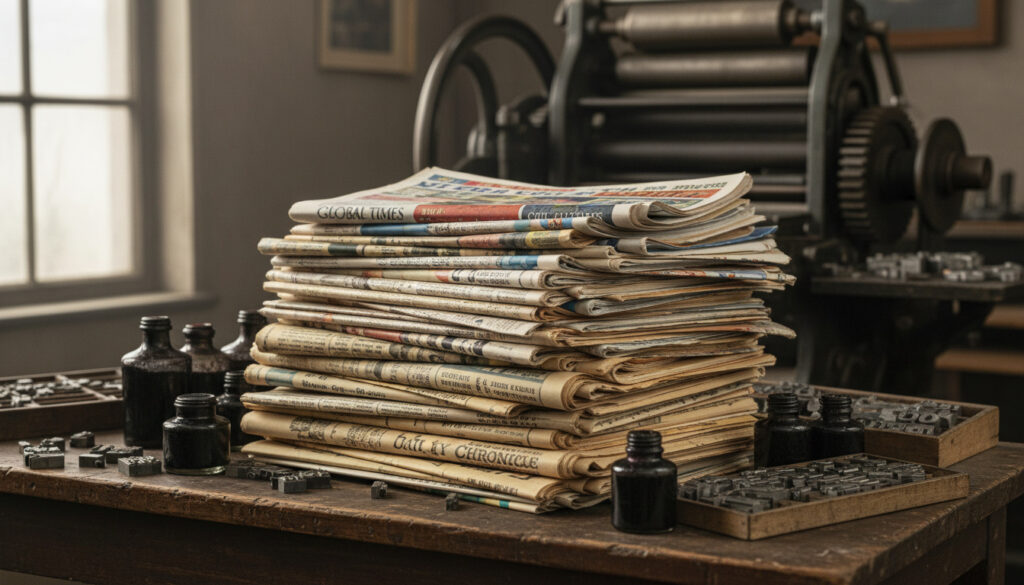
Newspaper – Definition, History, Types and Formats
A newspaper is a periodical publication, typically issued daily or weekly. It delivers news, views, features, opinion pieces, advertisements, and information on current events. Traditionally printed on inexpensive paper in black ink on a white or grey background, as noted by Wikipedia.
These publications have shaped public discourse for centuries. They range from broad national dailies to local weeklies, adapting content to diverse audiences.
Despite digital shifts, newspapers remain vital records of events, balancing print traditions with online presence.
What types and formats do newspapers take?
| Aspect | Description |
|---|---|
| Format | Broadsheet, tabloid, or Berliner sizes determine layout and style. |
| Frequency | Daily, weekly, semi-weekly, bi-weekly, or monthly issues. |
| Geography | National, regional, suburban, or ethnic distribution. |
| Content focus | Serious news, sensational stories, or community updates. |
- Broadsheets offer large pages with in-depth reporting for educated readers.
- Tabloids emphasise smaller formats and sensational topics like celebrities and sports.
- National dailies circulate country-wide, such as the Financial Times.
- Regional papers focus on local issues, like Metro Daily.
- Ethnic newspapers serve specific language communities, for example Le Droit.
- Berliner format measures 12.4 by 18.5 inches, between tabloid and broadsheet.
| Category | Description | Examples |
|---|---|---|
| Broadsheet | Large pages, serious in-depth news for educated readers. | Financial Times, Daily Mail, The New York Times, The Wall Street Journal. |
| Tabloid | Smaller format, sensational stories, celebrities, sports. | New York Post, The Sun (UK). |
| Berliner | Intermediate size (12.4 x 18.5 inches). | N/A. |
| National Dailies | Country-wide circulation. | Financial Times. |
| Metropolitan/Regional | Local/regional focus. | Metro Daily. |
| Suburban/Small Town | Local small-town news. | Daily Herald. |
| Ethnic | Targets specific language groups. | Le Droit. |
Details on Types and Formats highlight these variations, per Study.com and Fiveable.
How did newspapers originate?
Ancient beginnings
Origins trace to ancient Rome’s Acta Diurna in 59 BC. Public records of political, social, military, and other events appeared on metal or stone in forums.
Acta Diurna posted daily updates in Roman public spaces, acting as the first news bulletin.
Middle Ages circulation
Manuscript newsletters spread among traders in the late Middle Ages, notably the Fugger family.
Modern printed era
Europe saw the first printed newspapers in the early 17th century. Germany’s Relation aller Fürnemmen und gedenckwürdigen Historien dates to 1605.
Venice had handwritten weekly sheets from 1566. For deeper insights, explore Historical Development, as covered by Britannica.
What technological advances drove newspaper growth?
Johannes Gutenberg’s printing press in the mid-1400s enabled mass production.
By the 19th century, high-speed presses and advertising boosted global reach across Europe, the Americas, Asia, and the Middle East.
In the US, the New York Sun in the 1830s accelerated expansion.
Gutenberg’s invention shifted from handwritten copies to scalable printing.
What are the major milestones in newspaper history?
- : Acta Diurna in Rome posts public records. Quintype blog.
- Mid-1400s: Gutenberg’s printing press revolutionises production. Fiveable.
- 1605: First printed newspaper in Germany, Relation aller Fürnemmen…. Wikipedia.
- 1621: First English corantos in London.
- 1665: The London Gazette launches, twice weekly.
- 1650/1702: First daily, either Einkommende Zeitung (Leipzig) or Daily Courant (England).
- 1785: The Times sets quality standards in Britain.
- 1830s: New York Sun spurs US growth.
What facts about newspapers are established versus unclear?
| Established Information | Unclear or Debated |
|---|---|
| Acta Diurna as ancient origin (59 BC). | Exact first daily newspaper: 1650 Leipzig or 1702 London. |
| Gutenberg press (mid-1400s) enables mass print. | Precise transition from handwritten Venetian sheets (1566). |
| Relation aller… as first printed (1605). | Role of Fugger newsletters’ influence. |
| 19th-century global expansion via presses and ads. |
What purpose do newspapers serve?
Newspapers inform on current events and offer views, features, and opinions. They include advertisements to fund operations.
As periodicals, they provide structured updates, serving as records of record with editorial independence.
News, analysis, and ads form the backbone, sustaining public information flow.
Which sources support newspaper facts?
Newspapers trace origins to ancient Rome and evolved with printing technology.
Key milestones include Acta Diurna, early corantos, and dailies like The Daily Courant.
Funding relies on subscriptions and advertisements.
Additional references include University of Illinois guides on frequencies.
What defines newspapers today?
Newspapers blend tradition with adaptation. From ancient bulletins to digital models, they endure amid radio, TV, and online competition. Core elements—news, print legacy, diverse formats—persist, funded by subs and ads. See Historical Development for timelines. Related source: Australiainsight.
When was the printing press invented?
Mid-1400s by Johannes Gutenberg, enabling mass newspaper production.
What is a broadsheet newspaper?
Large-format publication with serious, in-depth news for educated audiences.
How often are newspapers published?
Frequencies cover daily, weekly, semi-weekly, bi-weekly, or monthly.
What is the oldest known newspaper precursor?
Acta Diurna from 59 BC in ancient Rome.
Are newspapers only print?
Many shifted to digital-first, with print secondary or discontinued.
What funds newspapers?
Subscriptions and advertisements primarily.
What is a tabloid?
Smaller format focusing on sensational stories, sports, and celebrities.
More related posts
 When Does FC 26 Come Out? Release Date, Early Access & More
 Audrey Hepburn: Nationality, Death, Children, and Faith
 The Twilight Saga Movies – Correct Watch Order Guide
 Demi Lovato: Diagnosis, Sobriety, Identity, and Life Updates
 Animal Crossing New Horizons – 2025 Guide and Overview
 Wes Streeting: Biography, Partner, Political Views and Health
 Garden Sheds for Sale in Ireland: Planning & Deals
 Clinton Baptiste: Real Name, Catchphrase & Tour 2026