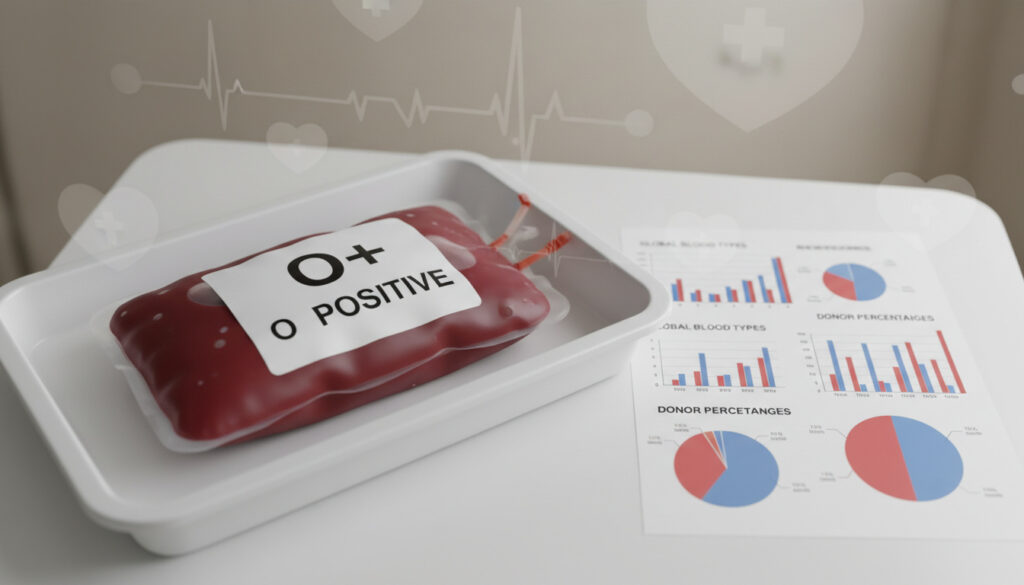
O Positive Blood Type – Facts, Prevalence, Donation Needs
O positive blood type dominates transfusion medicine as the most common classification globally. Approximately 38% of Americans and 36% of Britons carry this type, making it the backbone of hospital blood supplies worldwide.
The classification stems from the ABO system combined with the Rh factor. While O negative often receives attention as the universal donor, O positive serves as the workhorse for everyday medical emergencies, surgeries, and trauma care.
Understanding this blood type matters for donors and recipients alike. Compatibility rules determine who can receive O positive blood, while prevalence data explains why blood banks constantly seek donors with this classification.
What Are the Facts About O Positive Blood Type?
Approximately 35-40% of the global population carries O positive blood, making it the most common type in most regions.
Type O means no A or B antigens are present. The positive designation indicates the presence of the Rh D protein on red blood cells.
O positive donors can provide red blood cells to all Rh-positive recipients, covering roughly 85% of the population.
Recipients with O positive blood can receive transfusions only from O positive or O negative donors.
Key Characteristics
- O positive represents the single most requested blood type in hospital settings.
- The American Red Cross confirms that 38% of the U.S. population carries this type compared to just 7% with O negative.
- Type A positive ranks second in prevalence at roughly 33% in American populations.
- AB negative remains the rarest classification, representing less than 1% of U.S. residents.
- The Rh-positive factor appears in approximately 85% of the general population globally.
- O positive donors provide crucial support for trauma patients when blood type is unknown.
- Hospitals maintain larger inventories of O positive than any other classification.
| Fact | Detail |
|---|---|
| Global Prevalence | 35-40% (varies significantly by region) |
| United States | 38% of population |
| United Kingdom | 36% of population |
| Rh Factor Status | Positive (D antigen present) |
| Universal Donor Status | No – O negative holds this designation |
| Red Cell Donation Compatibility | O+, A+, B+, AB+ |
| Reception Compatibility | Can receive from O+ and O- only |
| Relative Rarity of O Negative | 7% in U.S. (significantly scarcer) |
| AB Negative Prevalence | Less than 1% in U.S. |
| A Positive Prevalence (U.S.) | Approximately 33% |
Is O Positive the Most Common Blood Type?
Statistical analysis confirms that O positive blood represents the most prevalent classification across diverse populations. Data from the American Red Cross establishes that more than one-third of Americans carry this type, significantly outpacing other classifications.
Regional Variations in Prevalence
While O positive dominates in Western nations, prevalence fluctuates across ethnic and geographic boundaries. Some Asian populations report lower rates, approximately 30%, though O types collectively remain predominant. Latin American and European populations frequently show higher concentrations, occasionally exceeding 40% in specific regions.
Comparison with Other Common Types
Type A positive competes closely in some populations, affecting roughly one in three individuals. However, O positive consistently maintains the top position in aggregated global data. The gap widens significantly when comparing against negative Rh types, which collectively represent only 15% of the population.
Because O positive serves patients with any positive blood type during emergencies, blood banks face constant pressure to maintain robust supplies despite its high prevalence among donors.
What Are the Advantages of Blood Group O Positive?
Health Risk Profiles
Research indicates that individuals with type O blood, including O positive, may experience lower risks for several serious conditions. Studies from Tufts University School of Medicine demonstrate reduced incidence of heart disease, blood clots, and stroke among O types compared to A, B, or AB classifications. This protective effect potentially stems from lower natural levels of clotting factors and cholesterol.
Additional research published in medical literature suggests O types face reduced risks of pancreatic cancer and severe COVID-19 complications. Some evidence indicates potential resistance to malaria infection and longer lifespans attributed to decreased cardiovascular risks. However, Northwestern Medicine notes that women with type O blood may exhibit lower healthy egg counts, potentially impacting fertility.
Donation Advantages
O positive donors provide unmatched versatility for Rh-positive recipients. Medical compatibility charts confirm that O positive red blood cells can safely transfuse into patients with O positive, A positive, B positive, or AB positive classifications. This covers approximately 85% of the population, making O positive donations among the most valuable contributions to blood banks.
While O positive serves as the universal donor for Rh-positive patients, only O negative blood can safely transfuse to anyone regardless of Rh status. This distinction becomes crucial during emergencies involving women of childbearing age or patients with negative blood types.
O Positive Blood Type Diet and Personality Traits
Examining Diet Claims
Popular books and alternative health sources often promote blood-type-specific eating plans, suggesting O positive individuals should consume high-protein diets heavy in meat and fish while avoiding grains and dairy. Healthline reports that no rigorous scientific evidence supports these recommendations. Large-scale clinical trials have failed to demonstrate that blood-type diets provide superior health outcomes compared to balanced nutrition.
Research published in the National Library of Medicine did identify some correlations between blood type and lifestyle choices, noting that Rh-positive individuals tend to consume more alcohol, caffeine, and vitamins C, D, E, and K than Rh-negative individuals. However, these associations do not translate to dietary prescriptions. Tufts Medical Center emphasizes that healthy eating, regular exercise, and smoking cessation benefit all blood types, particularly non-O types facing higher cardiovascular risks.
Personality Theories vs Evidence
Cultural traditions, particularly Japanese ketsuekigata theory, assign specific personality traits to blood types, characterizing O types as confident, optimistic, and assertive. NHS Blood and Transplant surveys confirm that no scientific link exists between blood type and personality, with large-scale studies in Japan and the United States finding no correlation.
While some transfusion medicine professionals acknowledge cultural beliefs about blood type and temperament, empirical research consistently demonstrates that self-assessments based on these categories remain unreliable. Walden University research affirms that personality development stems from environmental, genetic, and psychological factors unrelated to blood antigens.
Medical authorities caution against making dietary or lifestyle decisions based on blood type alone. Consulting healthcare providers for personalized nutrition and wellness advice ensures evidence-based care regardless of whether you carry O positive or any other classification.
How Was the O Positive Blood Type Discovered?
- : Austrian scientist Karl Landsteiner identifies the ABO blood group system, establishing the existence of types A, B, and O, earning the 1930 Nobel Prize in Physiology or Medicine.
- : Researchers discover the Rh factor (Rhesus factor), identifying the presence or absence of the D antigen that creates positive and negative designations within each ABO type.
- : Blood banking standardizes around the combined ABO-Rh classification system, establishing modern terminology including O positive.
- : Population genetics studies confirm O positive as the predominant blood type across most demographic groups, with prevalence rates stabilizing at 35-40% globally.
What Is Definitively Known About O Positive?
Established Facts
- O positive represents the most common blood type in the United States (38%), United Kingdom (36%), and Scotland.
- The Rh-positive factor appears in approximately 85% of the global population.
- O positive red blood cells can safely transfuse to any Rh-positive recipient (O+, A+, B+, AB+).
- Type O individuals generally face lower cardiovascular risks compared to other ABO groups.
- No scientific evidence supports blood type-specific diets or personality correlations.
Remaining Uncertainties
- Exact prevalence rates vary significantly across Asian populations, with some studies suggesting lower O positive rates (around 30%) requiring further demographic research.
- The precise mechanisms linking blood type to COVID-19 severity remain under investigation.
- Long-term fertility impacts specific to O positive women versus other Rh-positive types require additional longitudinal studies.
- Regional variations within Africa and South America need more comprehensive sampling.
Why Does O Positive Matter in Healthcare?
Hospital systems rely heavily on O positive blood inventory due to its compatibility with the majority of patients. In emergency situations where trauma victims require immediate transfusion before blood typing is completed, O positive serves as the safest option for most males and females beyond childbearing years. This utility explains why blood donation organizations prioritize O positive donors despite their numerical abundance.
The distinction between O positive and O negative becomes critical in specific medical contexts. While O negative remains the only truly universal donor type safe for all recipients, its scarcity (7% of the population) makes O positive the practical choice for massive transfusion protocols. Understanding these supply dynamics helps explain why health organizations constantly seek donations across all type O categories.
For individuals exploring personal health optimization, What Is Intermittent Fasting – Schedules, Benefits and Risks offers evidence-based approaches that apply universally, including to those with O positive blood.
What Do Medical Authorities Say About O Positive?
“Type O positive blood is given to patients more than any other blood type, which is why it’s considered the most needed blood type.”
— American Red Cross
“O positive is the most common blood type, so it’s always needed. Around 36% of the donor population has this blood type.”
— NHS Blood and Transplant
What Should You Know About O Positive Blood?
O positive blood type represents both statistical normality and medical necessity, serving as the primary resource for hospital transfusion services worldwide. While carriers enjoy potential health advantages regarding cardiovascular risks, the type’s greatest significance lies in donation potential. O positive donors provide life-saving support to the vast majority of patients needing red blood cell transfusions. Those uncertain of their blood type should consider testing, as Best Flea Treatment for Dogs – Top Vet Picks 2024 reminds us that precise biological knowledge enables better health decisions across species and systems.
Frequently Asked Questions
What is the rarest blood type?
AB negative represents the rarest blood type in the United States, affecting less than 1% of the population.
Can O positive donate to anyone?
No. O positive can donate red blood cells only to Rh-positive recipients (O+, A+, B+, AB+). Only O negative serves as the universal red cell donor.
What is the Rh factor?
The Rh factor is an inherited protein found on red blood cells. Rh-positive individuals (about 85% of people) possess this protein, while Rh-negative individuals lack it.
What blood types can O positive receive?
O positive recipients can safely receive red blood cell transfusions only from O positive or O negative donors.
Does blood type affect COVID-19 risk?
Some studies suggest type O individuals, including O positive, may face lower risks of severe COVID-19 complications, though research continues and all blood types remain vulnerable.
Should O positive people eat a specific diet?
No scientific evidence supports blood-type-specific diets. O positive individuals should follow general nutritional guidelines for balanced health.
More related posts
 UK Emergency Alerts Operator Tests: 2025 Date & Details
 How Old is Earth? 4.54 Billion Years: Science vs Religion
 Edward Woodward: Biography, Career, and Cause of Death
 Tom Blyth Movies and TV Shows: Complete Filmography List
 Sony WF-C700N – ANC Earbuds Specs and Performance Guide
 Tata Steel Port Talbot: News on Closure and Green Transition
 National Sea Life Centre Birmingham Tickets: Prices & Booking
 Virgin Media Pay Bill – Quick No-Login Guide