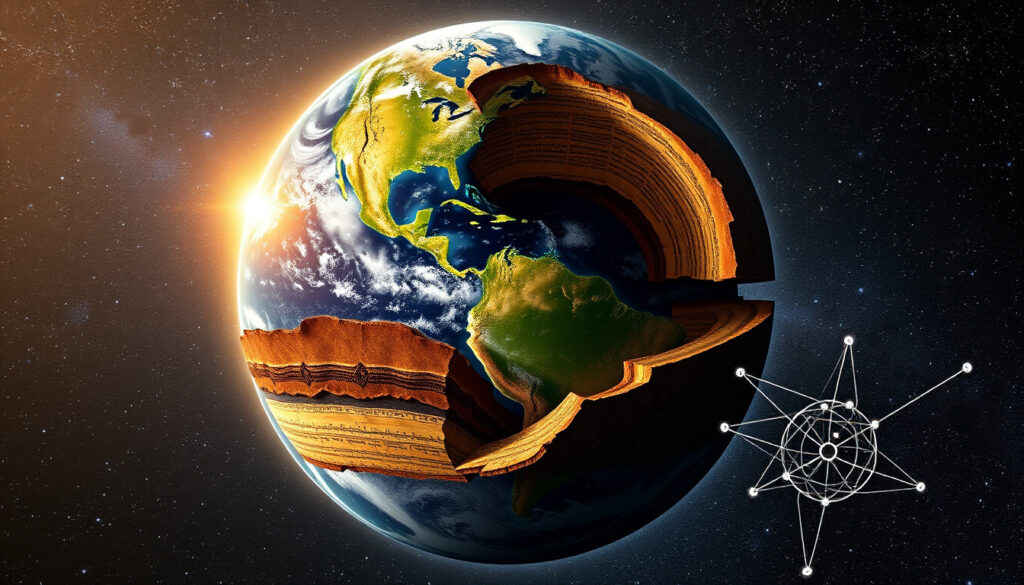
How Old is Earth? 4.54 Billion Years: Science vs Religion
If you stacked every human who ever lived end to end, they’d barely stretch to the Moon and back — and that’s using a generous estimate. The planet underfoot has been here roughly 4.54 billion years, which means our species is essentially a rounding error in Earth’s biography. This piece looks at how scientists landed on that number, what happened before humans showed up, and how some religious traditions arrived at very different answers.
Scientific Age: 4.54 billion years · Universe Age: 13.8 billion years · Human Appearance: 300,000 years ago · Life on Earth: 3.5 billion years ago
Quick snapshot
- Exact timing of first oceans remains disputed among geologists
- Precise origin point of life — hydrothermal vents vs. surface pools — still debated
- Radiometric dating breakthrough in early 20th century shifted estimates from thousands to billions
- Lord Kelvin’s 1862 estimate of 100 million years was overturned by radioactivity discovery in 1896
- Continued refinement of isotopic measurements may narrow the error margin further
- New dating of lunar samples could add precision to Solar System formation models
The key facts table below summarizes the most robust measurements of Earth’s age from scientific sources.
| Field | Value |
|---|---|
| Age | 4.54 ± 0.05 billion years |
| Formation Method | Accretion and differentiation |
| Solar System Age | 4.6 billion years |
| Oldest Rocks | 4.28 billion years |
| Earliest Life Evidence | 3.5 billion years ago |
| Oldest Zircon Crystals | 4.3 billion years |
How old is the Earth with humans?
The difference between Earth’s age and human history is less a gap and more a chasm. Our species, Homo sapiens, has walked this planet for roughly 300,000 years — a span that sounds impressive until you realize it represents less than 0.007% of Earth’s existence. The U.S. Geological Survey puts Earth’s formation at 4.54 billion years ago, based on lead isotope ratios from the Canyon Diablo meteorite.
Scientific timeline from formation to humans
After Earth coalesced from the solar nebula around 4.6 billion years ago, it took roughly 300 million years for the surface to cool enough to form solid crust. Oceans began pooling by 4.3 billion years ago, and the first primitive life — microbial mats and single-celled organisms — appears in the fossil record by 3.5 billion years ago. The National Park Service notes that Earth achieved its present mass during this accretion phase.
- 4.54 Ga: Earth accretion completes, planet reaches near-present size
- 4.3 Ga: First oceans form as surface temperature drops below water’s boiling point
- 3.5 Ga: Earliest confirmed microbial life in geological record
- 66 Ma: Dinosaurs go extinct, mammals diversify rapidly
- 300,000 years ago: Homo sapiens emerges in Africa
Humans are latecomers on a planet that spent billions of years preparing the conditions for our arrival. The atmospheric oxygen, liquid water, and temperate climate we depend on took eons to establish.
Key milestones in Earth’s history
The University of Hawaii Manoa explains that geologists divide Earth’s 4.5-billion-year lifespan into eons, eras, and periods. The Precambrian — spanning from formation to roughly 538 million years ago — accounts for about 88% of Earth’s entire history, yet most people could not name a single event from that span. Mass extinction events punctuate the later eras, with the Permian-Triassic die-off (252 million years ago) wiping out an estimated 96% of marine species.
When did human life first appear on Earth?
The question of when humans first appeared gets at something deeper: what makes us human in the first place. Fossil evidence places Homo sapiens in Africa around 300,000 years ago, but behavioral modernity — symbolic thinking, complex language, art — appears later, roughly 50,000 years ago according to most estimates. This gap between biological emergence and cultural expression is one of anthropology’s active debates.
Earliest hominins
Our lineage diverged from other apes roughly 6-7 million years ago, but “hominins” — members of the human family tree after that split — didn’t look much like us for most of their tenure. Australopithecus species walked upright in Africa starting around 4 million years ago, but they still had small brains and ape-like proportions. The genus Homo emerged around 2.8 million years ago, with brain size gradually expanding across multiple species.
Evolution to Homo sapiens
The transition from earlier Homo species to anatomically modern humans involved several populations mixing and competing across Africa and the Middle East. Neanderthals and Denisovans interbred with Homo sapiens, leaving traces in the DNA of most non-African populations today. By 12,000 years ago, the last Ice Age ended, and agriculture began reshaping human society permanently.
Who roamed the Earth before?
Before humans, Earth belonged to creatures that would seem alien today — or terrifying, depending on your perspective. Dinosaurs dominated for over 160 million years, which is roughly 533 times longer than Homo sapiens has existed. They were not the slow, stupid beasts of old cartoons but agile, warm-blooded animals many scientists compare to modern birds.
Pre-human life forms
Complex life didn’t spring into existence fully formed. The Ediacaran period (635-538 million years ago) left bizarre imprints of soft-bodied organisms that defy easy classification — frond-like creatures, flat discs, and tube forms that lived on ancient seafloors. The Planetary Society notes that life emerged roughly 3.5 to 4 billion years ago, but multicellular organisms took another few billion years to appear.
Dinosaurs and megafauna
Dinosaurs first appear in the fossil record around 230 million years ago and ruled the planet until 66 million years ago, when an asteroid impact off Mexico’s Yucatan Peninsula triggered global climate collapse. The extinction opened ecological niches that mammals rapidly filled. Ice Age megafauna — mastodons, giant ground sloths, saber-toothed cats — roamed until roughly 10,000 years ago, when human hunting and climate shifts drove most species to extinction.
If Earth’s 4.54 billion years were compressed into a single year, humans appear at 11:36 PM on December 31. The dinosaurs exist from mid-September through mid-December. The entire human civilization occupies the last 23 seconds.
How old is earth according to the Bible?
Biblical chronologies give answers that differ by orders of magnitude from scientific consensus — and even Biblical scholars disagree among themselves. The most famous calculation comes from Archbishop James Ussher, who in the 17th century dated Creation to 4004 BC based on Genesis genealogies. Modern young-Earth creationists typically arrive at roughly 6,000 years using similar methods, though the Creation Ministries International notes that the range spans from roughly 5,700 to 7,000 years depending on which textual tradition and historical anchors are used.
Young Earth creationism
Literal readings of Genesis place the creation of Adam around 4,000 BC, with all living things created during a literal six-day period. The Answers in Genesis organization maps out a detailed timeline: Creation Week in 4004 BC, the Biblical Flood in 2348 BC, Abraham in 1996 BC, and the Exodus from Egypt in 1491 BC. This “Ussher chronology” treats biblical genealogies as complete records, ignoring potential gaps in the genealogical lists.
The Institute for Creation Research offers a slightly different calculation, noting that the span from Adam to the Flood was approximately 1,656 years. If extended with post-Flood genealogical data, the total reaches around 6,000 years from creation to the present day.
Other interpretations
Not all Biblical readers arrive at young-Earth conclusions. The Sacred Calendar website presents an alternative chronology using the Septuagint (an ancient Greek translation of the Hebrew Bible) rather than the Masoretic text used by most modern Bibles. The Septuagint yields an older date for Creation — around 5500 BC compared to the Masoretic 4004 BC — because ancient copyists recorded slightly different ages for the patriarchs at the birth of their children. Gap theory, day-age theory, and framework hypothesis represent other approaches that attempt to reconcile Genesis with scientific findings.
The difference between 4.54 billion and 6,000 years isn’t simply a matter of rounding — it’s a factor of roughly 756,000. Both interpretations cannot be literally correct, and each carries significant implications for theology, science education, and how historical evidence is weighed.
How old is the universe?
Earth’s age sits within a larger cosmic context. The universe is roughly 13.8 billion years old, according to measurements of cosmic microwave background radiation by the Planck satellite and other observatories. This means Earth formed when the universe was already about 9.3 billion years old — a middle-aged planet in a middle-aged universe. The Geological Survey Ireland explains that Earth’s formation followed the collapse of a solar nebula that had itself been cooking for hundreds of millions of years following the Big Bang.
Relation to Earth formation
Our Sun ignited roughly 4.6 billion years ago from the same cloud of gas and dust that formed Earth and the other planets. The Sun contains about 99.8% of the Solar System’s mass, with the planets forming from residual material that coalesced over 50-100 million years. This means Earth is essentially a byproduct of star formation — we exist because a massive cloud of hydrogen collapsed at the right time and place.
Cosmic timeline
Stars formed first, then galaxies, then the elements heavier than hydrogen and helium through successive generations of stellar explosions. Our Solar System represents a third-generation stellar nursery — material that has been processed through multiple stars and supernovae. The atoms in your body are literally forged in stars that lived and died billions of years before Earth formed.
Viewing Earth as a relatively young planet in an ancient universe changes the scale of what “rare” or “ordinary” might mean. If our galaxy contains 100-400 billion stars, and many likely have planets, the conditions for life may be common — but still require billions of years of chemistry to develop.
Timeline of Earth’s age determination
How we learned Earth’s age is itself a story worth telling. Early estimates ranged from absurdly short to absurdly long, with scientific understanding advancing alongside discoveries in physics and geology.
- 1862: Lord Kelvin estimates Earth at 100 million years based on cooling rate, assuming the planet started as molten rock
- 1896: Henri Becquerel discovers radioactivity, providing a heat source Kelvin hadn’t accounted for
- 1907: Bertram Boltwood uses uranium-lead ratios to date rocks, finding ages of 92-570 million years
- 1911: Arthur Holmes dates Carboniferous rocks to 340 million years, Precambrian to 1.64 billion years
- 1927: Holmes refines his estimate to 1.6-3 billion years, noting that dated rocks post-date Earth’s formation
- 1941: EK Gerling estimates 3.2 billion years based on rock analysis
- 1956: Claire Patterson calculates 4.55 billion years using lead isotope ratios from meteorites — remarkably close to today’s accepted value
The breakthrough came from studying meteorites rather than Earth rocks, since terrestrial rocks have been recycled by plate tectonics and erosion. The Canyon Diablo meteorite, which struck Arizona 50,000 years ago, provided the sample that confirmed Earth’s age at 4.54 billion years.
Confirmed facts
- Earth formed 4.54 billion years ago based on multiple radiometric dating methods
- Oldest zircon crystals are 4.3 billion years old
- Solar System formed 4.6 billion years ago
- Life emerged 3.5-4 billion years ago
What’s unclear
- Whether life began at hydrothermal vents or surface pools remains debated
- Precise timing of first oceans within 100-million-year window
- Whether the earliest fossils represent life or abiotic chemical processes
Quotes on Earth’s age
The best age for the Earth (4.54 Ga) is based on old, presumed single-stage leads coupled with the Pb ratios in troilite from iron meteorites.
— U.S. Geological Survey
From Adam to the Flood was about 1,656 years. Adding subsequent genealogies yields approximately 6,000 years from creation to the present.
Earth formed roughly 4.6 billion years ago when it achieved its present mass, building up through collisions with smaller bodies in the early Solar System.
What these sources share is a commitment to working from evidence — whether that evidence takes the form of isotopic ratios in meteorites or genealogical records in scripture. The methods differ, the conclusions diverge, and the debate continues.
Summary
Earth’s age isn’t a mystery to science anymore — it’s settled to five significant figures. The 4.54 billion-year figure comes from decades of independent verification, and the error bars have narrowed to about ±50 million years. Religious perspectives offering dramatically younger ages rest on different assumptions about textual interpretation and historical methodology, creating a conflict that resists easy resolution. For readers curious about cosmic timescales, the scientific answer provides a framework for understanding our planet’s place in an ancient universe; for those grounding their worldview in scriptural authority, the same data presents a puzzle that may not have a comfortable answer.
Related reading: Scientific Age of the Earth
Related coverage: science-religion age analysis fördjupar bilden av How Old Is Earth – Science, Religion and Cosmic Timeline.
Frequently asked questions
How old is the Sun?
The Sun is approximately 4.6 billion years old, slightly older than Earth. It formed from the same solar nebula that created the planets, with the Sun containing 99.8% of the Solar System’s mass. Scientists estimate it has roughly 5 billion years remaining before expanding into a red giant.
How old is earth according to Islam?
The Quran does not specify Earth’s age in years, and Islamic scholars have reached varying conclusions. Some traditions, drawing on hadith literature or following Ussher-like chronologies, arrive at figures similar to young-Earth creationism (roughly 6,000-7,000 years). Others interpret Quranic references to creation’s “days” as long epochs, aligning more closely with scientific estimates. The diversity of views within Islamic scholarship makes generalizations difficult.
How old is earth according to Hinduism?
Hindu traditions describe cyclical time periods called kalpas, with one kalpa equaling approximately 4.32 billion years — a duration that falls closer to scientific estimates than literal Biblical interpretations. Hindu cosmology involves multiple cycles of creation and destruction across vast timescales that some scholars compare to scientific understandings of deep time.
Will life on Earth exist forever?
No. The Sun’s increasing luminosity will make Earth inhospitable within roughly 1-1.5 billion years as liquid water evaporates and the carbon cycle fails. Complex life will likely end long before the Sun’s red giant phase, which will either engulf Earth or vaporize it depending on mass loss rates during stellar evolution.
How old are the oldest rocks on Earth?
The oldest known rocks are approximately 4.28 billion years old, found in Canada’s Nuvvuagittuq Greenstone Belt and Australia’s Jack Hills region. These ancient rocks provide minimum dates for continental crust formation, though Earth itself is slightly older based on meteorite dating.
Why is Earth younger than the Solar System?
Earth formed roughly 100-200 million years after the Sun ignited, from material left over in the protoplanetary disk. The Sun and other planets formed simultaneously from the same solar nebula, but rocky planets like Earth took additional time to accumulate from smaller bodies through gravitational accretion.
What killed Lord Kelvin’s estimate?
The discovery of radioactivity in 1896 provided an internal heat source Kelvin hadn’t accounted for. Georges Darwin and John Joly noted in 1903 that radioactive decay within Earth’s mantle continuously generates heat, extending the cooling timeline far beyond Kelvin’s 100-million-year estimate. This discovery ultimately opened the door to billion-year timescales.
More related posts
 Port Lympne Wild Animal Park Tickets: Prices & Discounts
 Edexcel 2023 Grade Boundaries – Official GCSE & A-Level Tables
 Celebrity Race Across the World – Winners Cast Seasons Guide
 Crowne Plaza Gerrards Cross – Address Phone Spa Gym Weddings
 Fenella Fielding: Biography, Movies, and Why She Never Married
 Have I Got News for You: Cast, Hosts, Cancellation, and FAQs
 Incase or In Case – Correct Spelling and Usage Guide
 How to Induce a Period: Natural Remedies & Safe Methods