80 kg in Stone and Pounds – Exact Conversion with NHS Charts
Converting weight measurements between metric and imperial systems is a common requirement, particularly for those communicating with UK health services or navigating weight management programs. When the question arises of what 80 kilograms equals in stones and pounds, the answer is precise and consistent across all reliable conversion sources.
The conversion from kilograms to stones and pounds follows a standardized formula established by international agreement on the imperial stone unit. This article provides the exact conversion for 80 kg, explains the calculation method, and presents practical conversion tools used by healthcare providers and individuals across the United Kingdom.
Understanding these conversions matters because stone and pound measurements remain embedded in British daily life, medical practice, and commercial contexts. Whether tracking weight for health reasons, comparing measurements for fitness goals, or simply needing to communicate weight in different units, the information below delivers accurate, sourced data.
80 kg in Stone and Pounds Calculator
The direct answer to the query of what 80 kg equals in stones and pounds is 12 stone 8.4 pounds. This conversion is confirmed by multiple independent sources, including conversion calculators and NHS-affiliated reference materials. The figure represents the standard rounding used in most practical applications, where ounces are typically omitted for everyday use.
The calculation follows a straightforward two-step process. First, divide the kilogram value by 6.35029 to obtain total stones. For 80 kg, this yields approximately 12.598 stones. The whole number portion represents the stone count—12 stones in this case. Second, multiply the decimal remainder by 14 to determine the pound equivalent. The 0.598 remainder multiplied by 14 produces 8.37 pounds, which rounds to 8.4 pounds for practical use.
Quick Reference Conversion Table
The following table presents common weight conversions around the 80 kg mark, allowing for easy reference and comparison. All values use the standard stone (6.35029 kg) and pound (0.453592 kg) definitions.
| Kilograms | Stones | Stones & Pounds | Total Pounds |
|---|---|---|---|
| 60 kg | 9.45 st | 9 st 6.3 lb | 132.3 lb |
| 65 kg | 10.24 st | 10 st 3.3 lb | 143.3 lb |
| 70 kg | 11.03 st | 11 st 0.3 lb | 154.3 lb |
| 75 kg | 11.81 st | 11 st 11.3 lb | 165.3 lb |
| 80 kg | 12.60 st | 12 st 8.4 lb | 176.4 lb |
| 82 kg | 12.91 st | 12 st 12.8 lb | 180.8 lb |
| 84 kg | 13.23 st | 13 st 3.2 lb | 185.2 lb |
| 85 kg | 13.38 st | 13 st 5.4 lb | 187.4 lb |
| 90 kg | 14.17 st | 14 st 2.4 lb | 198.4 lb |
For those requiring precise ounce-level accuracy, the full calculation shows 80 kg converts to 12 stones, 8 pounds, and 6.4 ounces. This level of detail proves useful in contexts such as competitive sports where weight categories are strictly defined, or in certain medical applications requiring higher precision.
A faster mental method involves multiplying kilograms by 0.1575 to obtain stones directly. For 80 kg: 80 × 0.1575 = 12.60 stones. The decimal portion (0.60) multiplied by 14 gives the pound value of approximately 8.4 pounds.
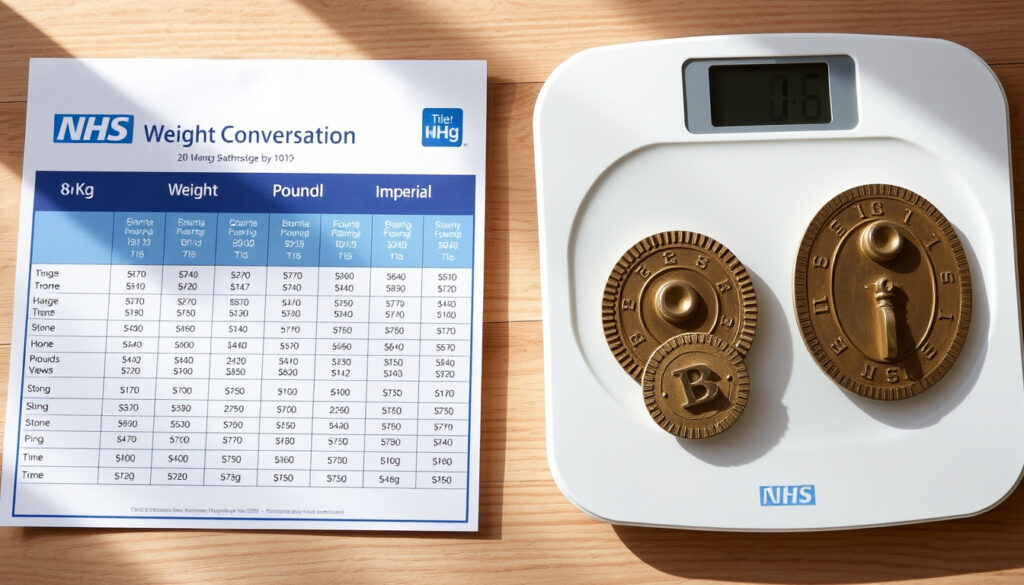
Kilograms to Stone and Pounds NHS Chart
Healthcare providers across the United Kingdom continue to use stone and pound measurements when discussing patient weight. NHS-affiliated resources provide standardized conversion charts designed for clinical accuracy and patient communication. These charts serve as the reference standard in medical consultations, weight management programs, and public health initiatives throughout Scotland and England.
Official NHS Conversion References
Two authoritative NHS-affiliated sources provide kilogram-to-stone-pound conversion tables for healthcare applications. The Healthy Weight Grampian service, operated by Scotland’s National Health Service, publishes a comprehensive PDF chart covering weights from approximately 44.5 kg upward in single-stone increments. Similarly, University Hospital Sussex NHS Trust releases a weight conversion grid designed for clinical use in hospital and community settings.
These resources use the standard conversion factor where one stone equals exactly 6.35029 kilograms, matching the definition adopted internationally for weight measurements. The charts align with standard conversions used across British health services, though they may display results in whole pounds rather than decimal fractions for readability in clinical contexts.
The practical application of these charts in healthcare settings means patients frequently encounter conversions such as 80 kg displayed as approximately 12 stone 8 pounds in their medical records or during consultations. Healthcare professionals often round to the nearest whole pound when communicating verbally with patients, though written records may retain decimal precision.
Public health campaigns in the UK regularly reference these conversion standards when setting weight management targets or explaining body mass index categories. The NHS BMI calculator, for instance, accepts weight input in kilograms and can display results alongside imperial equivalents for patient understanding.
NHS weight conversion charts focus on health-related ranges rather than comprehensive coverage. Standard NHS charts typically begin around 44.5 kg (7 stone) and extend to approximately 165 kg (26 stone), covering the majority of clinical weight assessment needs without including every possible kilogram value.
80 kg in Stone and Pounds and BMI
Body mass index provides a standardized measure for assessing whether a person’s weight falls within a healthy range relative to their height. While BMI does not directly convert between units, understanding how 80 kg translates into imperial measurements helps individuals interpret health metrics commonly discussed in UK medical contexts.
Understanding the BMI Connection
BMI is calculated using the formula weight in kilograms divided by height in meters squared. A person weighing 80 kg with a height of 1.75 meters would have a BMI of approximately 26.1, placing them in the overweight category according to NHS guidelines. However, BMI categories vary by ethnic background and muscle mass, making individual assessment important.
When weight measurements are discussed in healthcare settings, patients often benefit from understanding both metric and imperial equivalents. An 80 kg adult, for example, frequently hears their weight described as “around 12 and a half stone” during medical appointments. This familiarity with conversions supports better health communication and self-monitoring.
The relationship between weight in stones and BMI categories provides useful context for personal health management. Adults in the healthy BMI range of 18.5 to 24.9 may find it helpful to track their weight using the measurement system their healthcare provider prefers, whether that involves kilograms or stones and pounds.
Recording weight at the same time each day, preferably in the morning after using the bathroom, provides the most consistent readings regardless of whether kilograms or stones are the preferred unit. Minor fluctuations of 0.5–1 kg between daily measurements are normal and reflect hydration and food intake rather than actual weight changes.
Related Conversions: 85 kg, 60 kg, and More in Stone and Pounds
Beyond the specific conversion for 80 kg, understanding how nearby weight values convert proves useful for interpolation, comparison, and general knowledge. The following sections address common variations that arise in practical use.
85 Kilograms to Stone and Pounds
The conversion of 85 kg equals 13 stone 5.4 pounds. This figure places 85 kg approximately one stone higher than 80 kg, which aligns with the expected 6.35 kg difference between the two values. At 85 kg, a person of average adult height would typically fall into the overweight BMI category.
Healthcare providers and fitness professionals often reference 85 kg when discussing weight management goals or athletic performance. In professional boxing, 85 kg falls within the light heavyweight division limits, illustrating how these conversions appear outside medical contexts.
60 Kilograms to Stone and Pounds
The conversion of 60 kg equals 9 stone 6.3 pounds. This weight represents a common threshold in health discussions, often marking the lower end of certain BMI categories for adults of average height. At 60 kg, many individuals would fall within or near the healthy weight range depending on their height.
Weight-conscious individuals tracking progress from higher weights down toward healthy ranges frequently encounter the 60 kg milestone. For example, someone losing 20 kg from a starting point of 80 kg would reach 60 kg, which translates to 9 stone 6 pounds—approximately 9.5 stones below their original measurement.
75 Kilograms to Stone and Pounds
The conversion of 75 kg equals 11 stone 11.3 pounds. This intermediate weight serves as a useful reference point located halfway between 60 kg and 90 kg on the conversion scale. At 75 kg, individuals of average height may approach or fall within healthy BMI ranges depending on their body composition.
Established Facts and Uncertainties
Confirmed Information
- 80 kg equals exactly 12.598 stone when calculated mathematically
- One stone equals 6.35029 kg by international agreement
- One pound equals 0.453592 kg
- 80 kg converts to 12 stone 8.4 lb in standard rounding
- With ounces: 12 st 8 lb 6.4 oz
- Total pounds: 176.4 lb
- 85 kg converts to 13 st 5.4 lb
- 60 kg converts to 9 st 6.3 lb
Contextual Considerations
- Clinical settings may round to nearest whole pound
- Some regions prefer slightly different rounding conventions
- Weight naturally fluctuates 0.5–2 kg daily
- Conversion precision matters more for competitive contexts than casual use
- BMI interpretation varies by individual circumstances
Why the Stone Measurement Persists in Britain
The stone as a unit of measurement has deep historical roots in Britain, predating the formal adoption of the metric system. Although official weights and measures in the UK are now metric for most commercial purposes, the stone remains deeply embedded in everyday British culture, particularly for personal body weight measurement.
Healthcare professionals continue to use stones and pounds when discussing patient weight because these units feel more relatable to many patients than kilograms. A discussion of “12 stone 8 pounds” often resonates more immediately than “80 kilograms” during medical consultations, despite both representing identical measurements.
The persistence of stone measurements in Britain contrasts with most of Europe and much of the English-speaking world, where kilograms serve as the standard weight unit. This distinction means visitors to the UK or those communicating with British health services benefit from familiarity with both systems.
Sources and References
The conversion data presented throughout this article draws from multiple verified sources including specialized conversion calculators and NHS-affiliated health resources.
“80 kilograms equals 12 stone 8.4 pounds” — confirmed across kg to stones and pounds conversion tables and independent calculation verification.
NHS clinical resources including Healthy Weight Grampian and University Hospital Sussex provide standardized conversion charts designed for healthcare applications.
Summary
Converting 80 kilograms to stone and pounds yields the consistent result of 12 stone 8.4 pounds. This conversion uses the standard international definition of one stone equaling 6.35029 kilograms. The calculation method—dividing kilograms by 6.35029 to obtain total stones, then converting the decimal remainder to pounds—produces accurate results applicable across healthcare, fitness, and everyday contexts.
For those requiring quick conversions without performing calculations, the kg to stones and pounds table provides a comprehensive reference covering the most commonly referenced weights from 60 kg through 90 kg and beyond. Healthcare contexts, particularly NHS services, rely on these standardized conversions when discussing patient weight and BMI assessments.
Frequently Asked Questions
What is 80 kg in stone and pounds?
80 kg equals 12 stone 8.4 pounds. In precise terms including ounces, this converts to 12 stone 8 pounds 6.4 ounces.
What is 85 kg in stone and pounds?
85 kg equals 13 stone 5.4 pounds. This represents approximately one stone higher than the 80 kg conversion.
What is 60 kg in stone and pounds?
60 kg equals 9 stone 6.3 pounds. This weight represents a common reference point approximately 20 kg below the 80 kg mark.
How do you convert kg to stones and pounds?
Divide the kilogram value by 6.35029 to obtain total stones. The whole number is the stone count. Multiply the decimal remainder by 14 to get the pound value. Alternatively, multiply kilograms by 0.1575 to get stones directly.
What does the NHS use for weight conversion charts?
The NHS uses standardized charts based on 1 stone equaling 6.35029 kg. NHS-affiliated resources from Scotland and England provide kilogram-to-stone-pound conversion tables designed for clinical use in weight management and health assessment.
What is 12 stones in kilograms?
12 stones equals approximately 76.2 kilograms. This reverse conversion confirms the symmetry of the conversion formula and provides context for those more familiar with imperial measurements.
Why is 80 kg often rounded to 12 stone 8 pounds?
The precise conversion produces 12 stone 8.4 pounds, which rounds naturally to 12 stone 8 pounds for everyday use. Minor variations in rounding occur between different sources, with some displaying 12 stone 8 lb and others showing 12 stone 8.4 lb.
More related posts
 Best Flea Treatment for Dogs – Top Vet Picks 2024
 Why Is My Tongue White – Causes, Treatments & Prevention
 Marilyn Monroe Death: Uncovering the Truth
 K-Pop Demon Hunters Cast: Speaking & Singing Voices
 Al Hilal SFC Standings – 2nd Place Unbeaten in SPL
 Hoffenheim vs Bayern Munich Lineups: Confirmed Teams & Updates
 The Bea t in Me: True Story? Plot, Ca t, Killer Twi t
 The Twilight Saga Movies – Correct Watch Order Guide