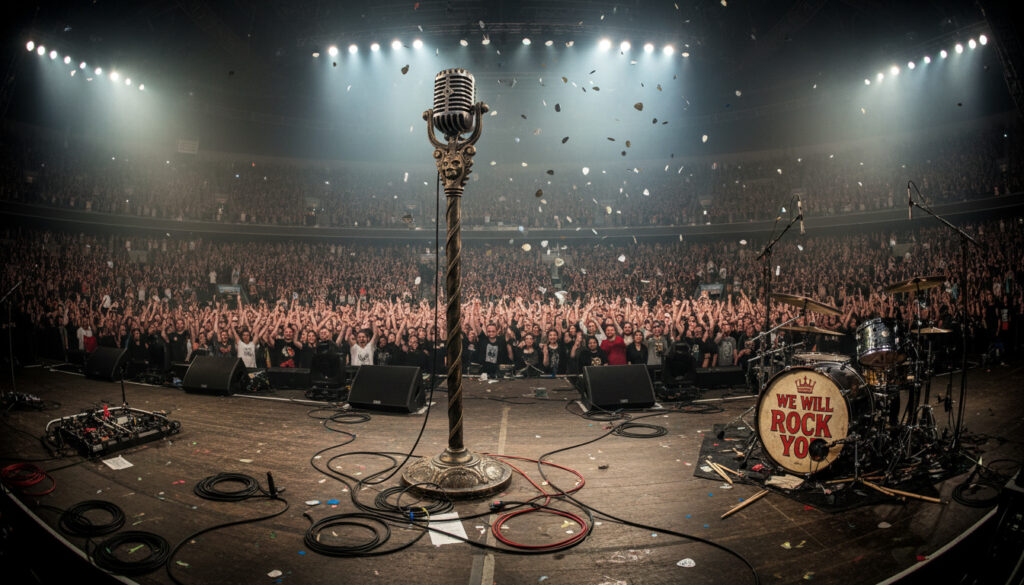
We Will Rock You – Lyrics, Meaning and Musical History
The stomp-stomp-clap rhythm has echoed through stadiums, arenas, and theaters across generations. Written during the height of Queen’s 1970s dominance, this track stripped rock instrumentation to its primal core— replacing drum kits with foot stamps and hand claps—to create one of the most recognizable audience participation anthems in music history.
Released in 1977 on the album News of the World, the composition emerged from guitarist Brian May’s desire to bridge the gap between performer and crowd. Drawing inspiration from the thunderous sound of wooden floors under stamping feet, May crafted a piece that functions simultaneously as rock song, theatrical centerpiece, and global sports rallying cry.
Nearly five decades later, the anthem maintains dual identities: the original a cappella-style studio recording featuring May’s concluding guitar solo, and the high-energy stage musical by Ben Elton that ran for twelve years in London’s West End. Both iterations continue to introduce the three-beat pattern to new audiences worldwide.
We Will Rock You Lyrics
- Depicts three stages of human life: childhood, adulthood, and old age
- Features no traditional drum kit, utilizing only body percussion recorded collectively
- Captured at Wessex Studios with band members, roadies, and staff participating
- Conceived after Queen’s 1976 Bingley Hall concert where crowds sang “You’ll Never Walk Alone”
- Released as UK No. 2 single paired with “We Are the Champions”
- Inducted into Grammy Hall of Fame in 2009
- Ranked No. 330 on Rolling Stone’s 2004 list of 500 Greatest Songs
| Aspect | Details |
|---|---|
| Artist | Queen |
| Album | News of the World |
| Writer | Brian May |
| Release Year | 1977 |
| UK Chart Peak | No. 2 |
| Recording Studio | Wessex Studios |
| Musical Premiere | 2002 (West End) |
| Grammy Recognition | Hall of Fame 2009 |
The lyrics trace a narrative arc through human existence, beginning with childhood rebellion (“Buddy, you’re a boy, make a big noise / Playin’ in the street, gonna be a big man someday”), progressing to adult aggression (“Buddy, you’re a young man, hard man / Shouting in the street, gonna take on the world someday”), and concluding with elderly reflection (“Buddy, you’re an old man, poor man / Pleadin’ with your eyes, gonna make you some peace someday”). American Songwriter notes this structure serves as both cautionary tale and unifying rallying cry, culminating in the chant “We will, we will rock you” and May’s concluding guitar solo.
Who Sings We Will Rock You?
Freddie Mercury delivered the lead vocals on the recording, though Brian May composed the piece specifically to maximize crowd interaction. The distinction matters because the song functions differently from traditional Queen material where Mercury’s piano often drove the composition.
The Composer’s Vision
May developed the melody after awakening from a dream, fixated on the thunderous resonance he imagined at Boston Garden. The immediate catalyst, however, occurred during the band’s A Day at the Races Tour in 1976, when fans at Bingley Hall in Stafford, England spontaneously sang “You’ll Never Walk Alone” as an encore. Wikipedia’s Queen archives document how this display of collective voice inspired May to create a song requiring no instruments—only the bodies of those present.
The rhythm track consists entirely of foot stomps and hand claps performed by the four band members together with their road crew and studio staff, captured at Wessex Studios without electronic percussion or drum machines.
From Studio to Stadium
The composition’s adaptability allowed Queen to deploy it differently across contexts. During their late 1970s and early 1980s tours, the band performed a substantially faster version as their concert opener, documented on Live Killers (1979) and the Rock Montreal film (1981). This uptempo arrangement energized crowds until “One Vision” replaced it as the opening number in 1986. The Songfacts database confirms these live variations lacked the studio version’s measured, ceremonial gravity.
We Will Rock You Tickets and Musical
Ben Elton’s theatrical production transformed the three-minute anthem into a two-and-a-half-hour narrative, running from 2002 to 2014 at London’s Dominion Theatre. The jukebox musical incorporates over 30 Queen songs within a dystopian storyline where live instrumentation has been banned and “Bohemians” fight to restore rock music.
The Stage Adaptation
The show’s narrative arc follows a group of rebels resisting the Globalsoft Corporation in a totalitarian future where musical instruments are outlawed. Unlike traditional musicals with original scores, this production weaves existing Queen catalog into the plot, with “We Will Rock You” serving as both title number and climactic rallying point. Wikipedia’s musical theater entry details its expansion into global tours spanning North America, Australia, and continental Europe.
Tickets for revivals and national tours are typically available through official Queen channels and licensed theater box offices, though current inventory varies by region and production schedule. The original West End production concluded its twelve-year run in 2014.
International Productions
Following its London premiere, the musical adapted for non-English speaking markets while retaining the original recordings. The show’s sports-adjacent energy has made it a staple at venues traditionally associated with athletic events, creating crossover audiences familiar with the anthem from Manchester United Ruben Amorim Record celebrations and similar milestone moments.
We Will Rock You Versions and Remixes
While the 1977 recording remains the definitive version, the composition exists in multiple documented iterations across film and live contexts. The 2018 biopic Bohemian Rhapsody incorporated the song within its depiction of the News of the World era, though sources do not specify exact scene placement within the film’s timeline.
Live Interpretations
Queen’s faster concert arrangement fundamentally altered the song’s character, transforming the stomping march into an urgent, driving opener. Documented on On Fire: Live at the Bowl (1982), this version emphasized Mercury’s vocal power over the communal participation central to the studio recording. The arrangement persisted until the band’s mid-1980s setlist changes.
Verified sources do not document an official Queen-sanctioned remix of the original 1977 recording. While unofficial versions and karaoke tracks circulate widely, specific remixed releases referenced in search data lack confirmation from band archives.
Cultural Appearances
The rhythm pattern has penetrated mainstream television, appearing in a 1998 Friends episode involving an answering machine gag and a 2015 Big Bang Theory scene where characters utilize the beat while changing a tire. Songfacts records these instances as evidence of the composition’s migration from rock anthem to universal cultural shorthand.
When Did We Will Rock You Debut?
- 1976: Brian May writes the song after Queen’s Bingley Hall concert in Stafford, England, inspired by crowd participation during “You’ll Never Walk Alone”
- 1977: Released on News of the World album and as UK single, peaking at No. 2 on charts
- 1978-1986: Fast live version employed as tour opener, documented on multiple concert films and live albums
- 2002: Ben Elton musical premieres at London’s Dominion Theatre on May 14
- 2009: Recording inducted into Grammy Hall of Fame; listed at No. 146 on RIAA’s Songs of the Century
- 2018: Featured in Bohemian Rhapsody biopic covering Queen’s trajectory through 1985 Live Aid [visual reference]
What Do We Know for Certain About We Will Rock You?
| Established Facts | Unclear or Unconfirmed |
|---|---|
| Written by Brian May | Specific post-2026 musical tour dates |
| Released in 1977 on News of the World | Official remix versions sanctioned by Queen |
| Depicts three life stages in lyrics | Exact timeline placement in Bohemian Rhapsody film |
| Recorded using body percussion only | Current availability of original multitrack recordings |
| Musical ran 2002-2014 in West End | Future theatrical licensing arrangements |
Why Does We Will Rock You Remain Iconic?
The track transcended rock music to become infrastructure for live events. Stadiums worldwide deploy the stomp-clap pattern to synchronize crowd energy during breaks in play, independent of the recording itself. This utility explains its persistence where other 1970s rock hits have faded from public arenas.
Its cinematic afterlife extends beyond the Queen biopic. The composition provides rhythmic scaffolding for sports highlights, political rallies, and product launches. When European football clubs face decisive fixtures—matches such as Real Sociedad vs Man United—the anthem frequently soundtracks pre-match buildups, connecting May’s 1976 vision to contemporary athletic theater.
Where Do These Facts Come From?
Brian May detailed the song’s genesis in multiple interviews, including a 2017 Rolling Stone conversation and a 2008 Mojo feature. American Songwriter’s analysis of the lyrical structure provides primary verification for the “three stages of life” interpretation.
I woke up with the melody, thinking about that amazing sound of thousands of people stamping their feet on wooden floors. I wanted to write something that would involve the audience in the making of the music.
Brian May, via American Songwriter and Songfacts archives
Additional verification regarding recording techniques and chart performance derives from Wikipedia’s extensively cited Queen article and the official Queen musical website.
What Is the Legacy of We Will Rock You?
The composition stands as one of rock’s most effective participatory mechanisms, bridging the gap between performer and audience through subtraction rather than addition—removing instruments to expose the rhythm of collective human movement. Its inclusion in the Bohemian Rhapsody film introduced the stomp-clap pattern to streaming-era audiences, while Manchester United Ruben Amorim Record celebrations and similar sporting milestones ensure the anthem remains audible in contexts far removed from 1970s rock venues. The musical, though closed in its original West End iteration, continues through touring productions that cement May’s initial vision of music as communal experience.
Frequently Asked Questions
Is there a We Will Rock You movie?
The song appears prominently in the 2018 biopic Bohemian Rhapsody, which covers Queen’s history through 1985. No standalone film adaptation of the Ben Elton musical has been confirmed.
Who holds the We Will Rock You musical rights?
The stage production features Ben Elton’s book with music by Queen. Specific licensing rights are managed through official Queen theatrical channels and authorized production companies.
What inspired the stomping beat?
Brian May drew inspiration from the sound of crowds stomping on wooden floors at Boston Garden and the participatory singing he witnessed at Bingley Hall during the 1976 tour.
Did Queen release an official remix?
Verified sources do not confirm an official Queen-sanctioned remix of the original 1977 recording. Various unofficial versions exist online, but these lack band authorization.
Does the musical still tour?
The original West End production closed in 2014 after twelve years. Revivals and regional tours have occurred subsequently, though current schedules vary by territory and production availability.
Who actually sings on the recording?
Freddie Mercury performed lead vocals on the 1977 studio version, despite Brian May having written the composition and guitar solo.
What do the lyrics represent?
The lyrics depict three stages of human life—childhood, adulthood, and old age—serving as both narrative progression and unifying rallying cry for audience participation.
More related posts
 Ranbir Kapoor Biography: Age, Net Worth, Wife, and Movies
 Eric Dane Cause of Death: ALS Diagnosis and Legacy
 DNA Test Ireland: Cost, Accuracy & Legal Guide
 The Traitors Season 1 – UK Winners Cast Eliminations Guide
 BBC Weather Bury St Edmunds: 14-Day Forecast & Temperature
 Personal Allowance 2024/25: UK Tax-Free Threshold Explained
 Gatwick Parking Promo Code 2026: PROMO26 + 70% Off Deals
 Zack Snyder’s Justice League Guide: Differences & Runtime