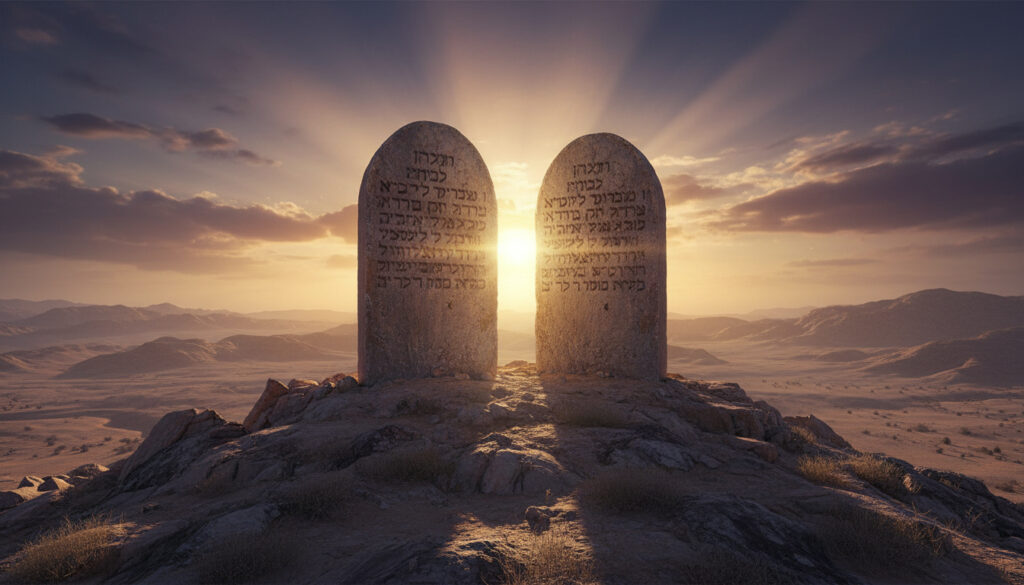
What Are the 10 Commandments – Full List, Verses and Differences
The Ten Commandments represent one of the most enduring moral codes in recorded history. Recorded in Exodus 20:1-17 and Deuteronomy 5:6-21, these instructions emerged from the covenant between God and Israel following the Exodus from Egypt, establishing specific duties toward the divine and toward fellow human beings.
Scholars recognize the Decalogue as the structural foundation of ethical monotheism in Western religious traditions. Historical analysis confirms these texts have influenced legal systems, artistic traditions, and moral philosophy across three millennia, functioning as touchstones for Jewish, Christian, and Islamic ethics as well as secular legal frameworks.
The commandments appear in three distinct biblical accounts: the initial giving at Sinai in Exodus 20, Moses’s retrospective in Deuteronomy 5, and the renewal narrative in Exodus 34 following the golden calf incident.
What Are the 10 Commandments?
The traditional enumeration follows the Protestant and Jewish division, separating the prohibition against other gods from the ban on graven images, and combining the various forms of coveting into a single commandment. This structure yields ten distinct instructions ranging from theological obligations to social ethics.
| Commandment | Summary | Verse | Core Principle |
|---|---|---|---|
| 1 | No other gods before me | Exodus 20:3 | Exclusive monotheism |
| 2 | No graven images or likenesses | Exodus 20:4-6 | Aniconic worship |
| 3 | No vain use of God’s name | Exodus 20:7 | Reverence |
| 4 | Remember the Sabbath day | Exodus 20:8-11 | Rest and creation |
| 5 | Honor father and mother | Exodus 20:12 | Family authority |
| 6 | Do not kill | Exodus 20:13 | Sanctity of life |
| 7 | Do not commit adultery | Exodus 20:14 | Marital fidelity |
| 8 | Do not steal | Exodus 20:15 | Property rights |
| 9 | No false witness | Exodus 20:16 | Truth in justice |
| 10 | Do not covet | Exodus 20:17 | Internal ethics |
- The commandments divide into two tablets: duties to God (1-4) and duties to neighbor (5-10).
- They were given directly by divine voice at Sinai, not mediated through Moses initially.
- Three biblical versions exist with minor textual variations in Sabbath rationale.
- The prohibition against killing specifically refers to unlawful homicide, not all killing.
- Coveting addresses internal desire, making it unique among ancient Near Eastern law codes.
- Precedents appear in Genesis, suggesting the commands predate Sinai.
- The text influenced Roman law and modern Western legal concepts of property and truth.
| Attribute | Detail |
|---|---|
| Origin Location | Mount Sinai |
| Traditional Date | ~1446 BCE |
| Original Medium | Stone tablets |
| Biblical Books | Exodus 20, Deuteronomy 5, Exodus 34 |
| Language | Biblical Hebrew |
| Literary Form | Apodictic law (absolute commands) |
| Numbering Traditions | Jewish, Protestant, Catholic, Orthodox |
Where Are the 10 Commandments Found in the Bible?
The primary textual witnesses appear in Exodus 20 and Deuteronomy 5. The Exodus account frames the Sabbath around creation, noting God rested on the seventh day after making heaven and earth. Deuteronomy shifts the rationale to liberation, commanding rest because God brought Israel out of Egyptian slavery.
Biblical scholarship documents a third version in Exodus 34, often called the Ritual Decalogue. This renewal occurs after Moses shatters the original tablets upon discovering the golden calf idol. The chapter lists ten commandments focused on worship practices rather than the ethical prohibitions found in Exodus 20.
Despite variation in Sabbath rationale between Exodus and Deuteronomy, the core prohibitions and commands remain consistent across all three biblical occurrences. Ancient manuscript traditions show remarkable textual stability for these passages compared to other ancient Near Eastern legal texts.
Catholic vs Protestant 10 Commandments: Key Differences
Numbering differences stem from how traditions group the opening verses and the final prohibition against coveting. Comparative analysis reveals that Jewish and Protestant traditions separate the command against other gods (Exodus 20:2-3) from the prohibition against images (20:4-6), while Catholic and Lutheran traditions combine these into a single first commandment.
| Tradition | First Commandment | Ninth Commandment | Tenth Commandment |
|---|---|---|---|
| Jewish/Protestant | No other gods | No false witness | No coveting (general) |
| Catholic/Lutheran | No other gods + no images | No coveting neighbor’s wife | No coveting goods |
Catholic numbering splits the coveting prohibition into two distinct commands: one against coveting a neighbor’s wife (ninth) and another against coveting goods (tenth). This reflects Augustine’s interpretive tradition emphasizing lust versus greed as distinct vices. Protestant numbering maintains the Jewish tradition of combining all coveting into one commandment while separating the image prohibition to stress iconoclasm.
These variations represent interpretive traditions rather than disputes over the actual biblical text. All traditions draw from identical verses in Exodus and Deuteronomy; the differences lie solely in how verses are grouped and numbered.
What Do the 10 Commandments Mean?
Theological analysis divides the Decalogue into two tables: the first four commandments address love of God, while the final six address love of neighbor. This structure reflects Jesus’s summary of the law, though the Decalogue predates his formulation by over a millennium.
The opening commands establish exclusive worship of Yahweh, rejecting polytheism and idolatry in all forms. The Sabbath command serves as a temporal boundary, sanctifying time itself through rest and remembrance. The fifth commandment bridges the two tables, connecting family honor—a vertical obligation to parents—with the horizontal ethics of the remaining commands.
Commandments six through nine prohibit external actions: murder, adultery, theft, and perjury. The tenth commandment uniquely prohibits internal desire—coveting—making it impossible to enforce through human courts and establishing morality as a matter of heart intention rather than mere behavior.
The Hebrew term for “kill” in the sixth commandment specifically denotes murder or unlawful killing, distinguishing it from judicial execution or warfare. Similarly, the prohibition against bearing false witness targets legal testimony rather than casual lying, protecting the Israelite judicial system from corruption.
How Did the 10 Commandments Emerge Historically?
- ~1446 BCE: Traditional dating for the theophany at Mount Sinai, where Exodus 20 records God speaking “all these words” directly to Israel.
- First Tablets: God writes the commandments on stone tablets, which Moses carries down the mountain.
- Golden Calf Incident: Moses breaks the tablets upon finding Israel worshipping an idol.
- Second Tablets: Exodus 34 records the renewal, with God commanding Moses to cut new tablets and inscribing them again.
- Deuteronomy Retelling: ~40 years later, Moses reiterates the commands to the new generation entering Canaan, with subtle shifts in emphasis reflecting the wilderness experience.
- New Testament Era: Early Christian texts reference the commandments as ongoing ethical standards, particularly in Pauline epistles and the Gospels.
What Remains Certain or Debated?
| Established Information | Areas of Uncertainty |
|---|---|
| Divine origin according to biblical narrative | Precise archaeological correlation with Sinai |
| Location at Mount Sinai/Horeb | Exact wording of first tablets (broken) |
| Two main versions: Exodus and Deuteronomy | Historical dating (ranging from 15th to 13th century BCE) |
| Influence on Western legal traditions | Process of literary composition and redaction |
| Three biblical occurrences | Original shape of the stone tablets |
What Is the Historical and Cultural Context?
The Decalogue emerged within the ancient Near Eastern treaty tradition, where suzerain kings imposed stipulations upon vassal states. Unlike the Code of Hammurabi or other cuneiform law collections, the Ten Commandments address a broader population rather than just regulating specific disputes. They also lack the conditional “if…then” structure typical of Mesopotamian codes, instead delivering absolute imperatives.
These commands functioned as the charter document for Israelite nationhood, establishing a theocratic social order without intermediary kings or priests in their original delivery. Are You There God It’s Me Margaret – Book Summary, Movie and Facts explores how modern literature engages with religious upbringing and moral formation, reflecting the ongoing cultural dialogue with these biblical texts.
The influence extends into contemporary media and education, where the tablets remain visual shorthand for absolute morality. 10 Best Movies on Netflix – October 2024 Top Picks by Genre includes films that grapple with themes of moral law and ethical dilemma, demonstrating how the Decalogue continues to frame narrative conflict in popular culture.
What Do Primary Sources Reveal?
“And God spake all these words, saying, I am the LORD thy God, which have brought thee out of the land of Egypt, out of the house of bondage.”
— Exodus 20:1-2 (KJV)
“Thou shalt not bear false witness against thy neighbour.”
— Exodus 20:16 (KJV)
What Is the Enduring Significance?
The Ten Commandments persist as a foundational ethical framework precisely because they address both public behavior and private intention, establishing minimum standards for social cohesion while demanding internal moral consistency. Their survival across three millennia of cultural change suggests a unique adaptability to varying political and social contexts, from ancient tribal confederations to modern constitutional democracies.
Common Questions About the 10 Commandments
Where else are the 10 Commandments mentioned in the Bible?
Beyond Exodus 20 and Deuteronomy 5, they appear in Exodus 34 as the Ritual Decalogue. Leviticus 19 echoes several commands, and both Old and New Testaments reference them indirectly through summaries of the law.
Who wrote the 10 Commandments on the stone tablets?
According to Exodus 31:18 and 32:16, God wrote the first tablets with his own finger. After Moses broke them, Exodus 34 states God commanded Moses to cut new stone, and God wrote on these second tablets as well.
Why do some traditions count the Sabbath as the third commandment?
In Catholic and Lutheran numbering, combining the first two commands (no other gods and no images) shifts all subsequent numbers forward, making the Sabbath commandment the third rather than the fourth.
Did the 10 Commandments exist before Moses?
Genesis contains precedents for several commands, including prohibitions against adultery (Genesis 39) and idolatry (Genesis 35:2), suggesting the ethical principles predate the Sinai codification even if the formal Decalogue emerged there.
What is the difference between “kill” and “murder” in the sixth commandment?
The Hebrew word “ratsach” specifically means unlawful killing or murder, distinguishing it from killing in war, self-defense, or judicial execution. This distinguishes the commandment from absolute pacifism.
More related posts
 Best Flea Treatment for Dogs – Top Vet Picks 2024
 Zack Snyder’s Justice League Guide: Differences & Runtime
 Paul Sun-Hyung Lee: Biography, Wife, Movies & TV Shows
 LG 65 Inch TV – UK Prices, OLED Models and Deals 2025
 The Garden at 120 Tickets – Prices, Availability, Buying Guide
 How to Pay Stansted Drop Off: Fees, Penalties & Grace Period
 Amazon UK Contact Number 0800 0345 Free Number – Official Guide
 Al Hilal SFC Standings – 2nd Place Unbeaten in SPL