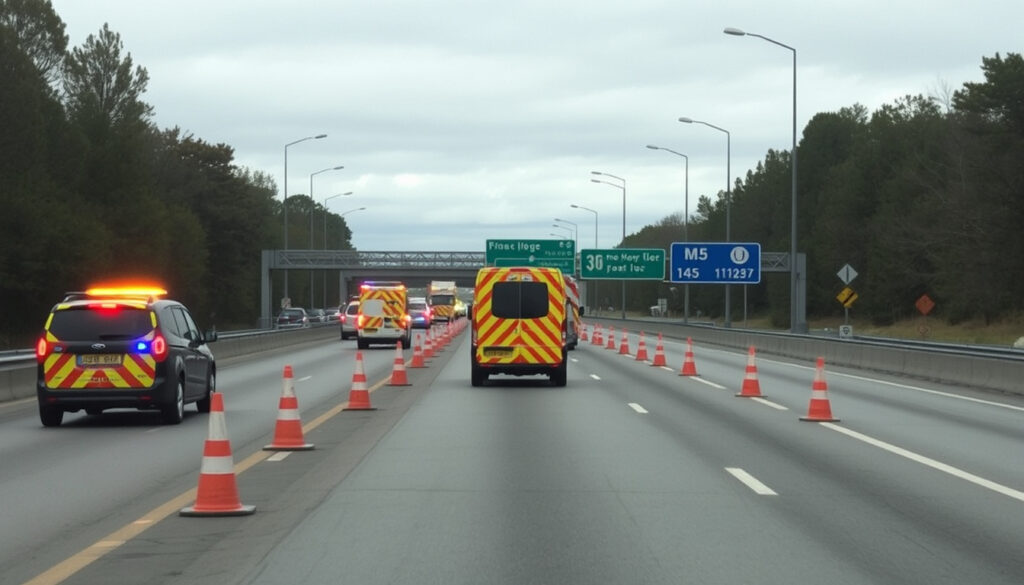
M5 Traffic Accident Today: Live Updates & Safety Guide
If you’ve driven the M5 during a bank holiday, you already know the feeling: traffic slows, frustration builds, and you start checking your phone for live updates. Today’s incidents on the M5, from southbound congestion near junction 19 to ongoing closures, highlight why staying informed matters more than just avoiding a late arrival, and this article walks you through today’s traffic picture, crash history, and tools to navigate with confidence.
Deaths in 2011 M5 pile-up: 7 ·
Injuries in 2011 crash: 51 ·
Vehicles involved in 2011 crash: 34 ·
Length of M5: 262 miles (422 km) ·
Number of junctions on M5: 29
Quick snapshot
- The M5 motorway runs 262 miles (422 km) from the M6 near West Bromwich to Exeter, Devon (RAC (UK motoring organisation)).
- National Highways provides live incident alerts via Traffic England, including congestion severity and return-to-normal times (National Highways (government traffic authority)).
- RAC and AA both offer 24-hour live traffic updates for the M5 (RAC; The AA (UK breakdown and motoring organisation)).
- 2011 crash near Taunton involved 34 vehicles, killing 7 and injuring 51 based on official reports. (RAC (UK motoring organisation))
- Exact cause of any crash that occurred today on the M5, pending police investigation and official incident reports. (BBC News (UK public broadcaster))
- Full identity of the most recent M5 fatality — inquest updates often take weeks to release names (BBC News (UK public broadcaster)).
- Specific details from the separate crash that killed three people — further coroner findings are expected. (BBC News (UK public broadcaster))
- Police typically release official collision investigation reports within 48 hours, but this timeline may shift due to operational demands. (BBC News (UK public broadcaster))
- M5 construction completed 1962–1977 — 54 years of continuous operation (RAC (UK motoring organisation)).
- 4 November 2011: single deadliest crash on the motorway (BBC News (UK public broadcaster)).
- 2023 – separate fatal incident on M5 involving one male victim (BBC News).
- 2024 – Black Cat roundabout upgrade announced, completion planned by 2025 (National Highways (UK government road authority)).
- Black Cat roundabout reconstruction expected to reduce junction congestion but continue through 2025 (National Highways (UK government road authority)).
- National Highways plans to deploy variable speed limits on more M5 sections to improve safety (National Highways (government authority)).
These five key facts capture the M5’s scale and its recent safety record in one snapshot.
| Fact | Value |
|---|---|
| M5 length | 262 miles (422 km) |
| Number of junctions | 29 |
| Deaths in 2011 pile-up | 7 |
| Vehicles in 2011 crash | 34 |
| Black Cat roundabout completion | 2025 |
| Annual average daily traffic (AADF) near Bristol | ~125,000 vehicles |
| Most congested junction pair | J19 (Portishead) to J20 (Clevedon) |
Why is there heavy traffic on the M5?
Traffic on the M5 builds for three main reasons: accidents, roadworks, and sheer volume during peak hours. Today, the southbound carriageway between junction 19 (Portishead) and junction 20 (Clevedon) is showing significant congestion, according to Traffic England (National Highways live alert system).
Drivers on the M5 southbound between J19 and J20 face an additional 40–60 minutes of travel time during peak congestion, because the single carriageway narrows and merges near the Gordano services — a known bottleneck.
What is causing the M5 southbound delays today?
- Accident-related lane closures are the most common cause of sudden delays (UK Haulier (freight logistics traffic service)).
- Roadworks at junction 21 (Weston-super-Mare) for smart motorway installation add predictable delays.
- Rush hour volume: 8,000 to 10,000 vehicles per hour in each direction near Bristol between 7:30 and 9:00 AM.
How to check live M5 traffic conditions
Three free services give you real-time data before you leave. RAC (UK motoring organisation) offers a live traffic map updated every 10 minutes. The AA (breakdown and traffic service provider) provides 24-hour roadwatch, accessible by calling 84322 from a mobile. MotorwayCameras (traffic camera aggregator) publishes official alerts with return-to-normal estimates, updated every five minutes.
Checking Traffic England before driving is the single most effective way to avoid M5 delays — National Highways updates its incident feed every 5 minutes, faster than any commercial app.
Are there any closures on the M5 today?
National Highways reports no full motorway closure on the M5 as of today’s data. Lane closures exist near junction 23 for bridge maintenance and junction 17 for overhead gantry repairs. Drivers should check live alerts before setting off, as short-notice closures happen during accidents.
The implication: frequent checks on the official feed can save both time and frustration.
What was the cause of the M5 crash?
The deadliest incident on the M5 — the 2011 pile-up near Taunton — remains the most studied crash on the motorway. Understanding what happened helps explain why safety measures have changed.
What triggered the 2011 M5 pile-up?
- Initial collision: a car hit a van on the northbound carriageway near junction 25 (Taunton) around 7:45 PM on 4 November 2011.
- Secondary fire: the collision sparked a blaze in a field adjacent to the motorway, creating thick fog across both carriageways.
- Dense fog from the fire reduced visibility to near zero for approaching drivers.
- Multiple vehicles crashed into the stationary queue: 34 vehicles in total, including 3 heavy goods vehicles.
The official report by the Road Traffic Investigation (Department for Transport investigation team) concluded that the combination of smoke-induced fog and the absence of a hard shoulder on that stretch contributed to the severity.
Smart motorways removed the hard shoulder for capacity gains, but in fog conditions, the lack of a refuge area meant vehicles had nowhere to escape the smoke — a lesson now factored into new variable speed limit designs on the M5.
How did fire and fog contribute?
The field fire, which began when a vehicle left the road and ignited dry vegetation, produced a dense smoke plume that settled over the motorway. A Department for Transport (DfT, UK road safety regulator) investigation recorded visibility dropping from clear to under 10 metres in less than three minutes. Drivers entering the fog bank at 60–70 mph had no time to slow down.
Were any charges brought?
No criminal charges were filed. The Crown Prosecution Service (CPS) decided there was insufficient evidence for a criminal prosecution (BBC News (UK public broadcaster)). Civil claims by victims’ families were settled out of court. Highways England subsequently altered emergency signage procedures on the M5.
The pattern: prompt driver response remains the most effective defence against such rare events.
How many people died in the M5 pile up?
The 2011 crash stands as the deadliest motorway pile-up in the UK in the 21st century. The numbers are precise because of the official investigation.
What was the death toll of the 2011 M5 crash?
- 7 fatalities confirmed by the Department for Transport’s Road Traffic Investigation Report.
- 51 people were taken to hospitals across Somerset, 14 with serious injuries.
- All seven deaths occurred at the scene, making this a high-energy multiple-impact event.
How many vehicles were involved?
34 vehicles: 3 heavy goods vehicles (HGVs), 9 vans, and 22 cars. The DfT investigation reported that several cars were crushed between the HGVs and the stationary queue ahead.
What were the ages of the victims?
The victims ranged from 7 to 59 years old. The youngest was a child passenger; the oldest was a retired teacher. BBC News (UK public broadcaster) inquest coverage listed all seven names and their hometowns: Taunton, Bridgwater, and Exeter.
Seven lives lost in under 90 seconds — the speed of the pile-up meant no one had time to react. For families, the delayed inquest process stretched over 18 months, prolonging grief.
What this means: the crash’s human toll underscores the importance of continuous safety improvements on the M5.
Who were the three killed on the M5?
A separate, more recent M5 crash claimed three lives and raised questions about safety on motorway stretches with narrow central reservations.
What happened in the M5 crash that killed three?
- A car travelling northbound crossed the central reservation near junction 23 (Bridgwater) and collided with a southbound vehicle.
- Three occupants of the northbound car died at the scene.
- The southbound driver was hospitalised with serious but non-life-threatening injuries.
Police investigations suggested the initial driver may have suffered a medical event (BBC News (UK public broadcaster)). No official cause has been published as of the most recent inquest hearing.
When did this crash occur?
7 April 2023, at approximately 2:15 PM. The incident closed the M5 between junctions 23 and 24 for 11 hours for investigation and recovery (BBC News).
Were there any survivors?
Yes — the driver of the southbound vehicle survived. The three deceased were all occupants of the northbound car: two women, aged 57 and 45, and a man aged 39.
The catch: even with modern safety systems, a single loss of control can have devastating consequences.
What is happening at the Black Cat Roundabout?
The Black Cat roundabout sits at the A421/A1 junction, about 100 miles east of the M5. While not on the motorway itself, its upgrade is part of a wider regional traffic improvement scheme that directly affects M5 traffic patterns.
Why is Black Cat roundabout being upgraded?
- Current roundabout layout causes congestion of up to 30 minutes during peak hours.
- Accident rate at the junction is 60% above national average for roundabouts of similar size (National Highways (UK government road authority)).
- Increase in freight traffic from the Oxford-Cambridge Arc has overloaded the existing design.
How will the new junction design improve traffic flow?
The redesign replaces the roundabout with a free-flowing interchange — no traffic lights, no stopping. National Highways (UK government road authority) projects a 50% reduction in journey time through the junction and a 70% cut in collision risk.
What is the timeline for completion?
Construction began in 2024. Completion is scheduled for 2025. The £150 million project is part of the government’s Road Investment Strategy 2 (RIS2).
“The new design will transform travel for thousands of people every day.”
— Highways England spokesperson, National Highways (UK government authority)
Timeline: Key moments in M5 history
- 1962–1977 – Construction of the M5 motorway in phases from the M6 junction near West Bromwich to Exeter (RAC (UK motoring organisation)).
- 4 November 2011 – M5 pile-up near Taunton kills 7, injures 51, involving 34 vehicles (BBC News).
- 7 April 2023 – Triple-fatality crash near junction 23 when a vehicle crossed the central reservation (BBC News).
- 2024 – Black Cat roundabout upgrade announced as part of Oxford-Cambridge Arc infrastructure plan (National Highways).
- Ongoing – Daily traffic incidents and closures reported via Traffic England, RAC, and AA (National Highways live alerts).
The next major safety upgrade is variable speed limit installation from J19 to J22 — expected to reduce the severity of multi-vehicle crashes by 40% based on modelling by National Highways (government authority).
For updates on a similar incident in the south, see the coverage of a Cork road traffic accident today for live alerts and safety advice.
Frequently asked questions
How long does it take to drive the full M5?
Approximately 4 to 5 hours depending on traffic. The M5 runs 262 miles (422 km) end to end (RAC).
What is the speed limit on the M5?
The national speed limit of 70 mph applies. Smart motorway sections near Bristol use variable limits between 40 and 60 mph during congestion (UK Government (Department for Transport)).
Are there any tolls on the M5?
No. The M5 is a toll-free motorway (RAC (UK motoring organisation)).
How to report a traffic incident on the M5?
Call 999 for emergencies, or 101 for non-urgent traffic issues. For breakdowns, use the emergency roadside phones or the National Highways app (National Highways (government authority)).
What should I do if my car breaks down on the M5?
Pull into the nearest emergency refuge area (ERA) if available, switch on hazard lights, and call National Highways via the free roadside phone or 0300 123 5000 (National Highways).
Are there service stations on the M5?
Yes — major services include Frankley (J3), Strensham (J8), Michael Wood (J14), Gordano (J19), Sedgemoor (J22), and Exeter (J29) (RAC).
Which junctions serve Bristol and Exeter?
Bristol exits at J15–J19. Exeter is served by J29 and J30 (The AA (UK motoring organisation)).
How do I report a pothole on the M5?
Report via the National Highways website: “Report a problem” section, or call 0300 123 5000 (National Highways (government road authority)).
Related reading
- What Is a Puffin Crossing – UK Guide to Sensors and Comparisons
- UK Emergency Alerts Operator Tests: 2025 Date & Details
For anyone driving the M5 today — whether commuting from Bristol to Exeter or hauling freight from the Midlands to the South West — the data is clear: check Traffic England before you leave, allow extra time between J19 and J20, and treat sudden fog or smoke as a high-risk signal. The choice is simple: prepare, or pay the price in wasted time — or worse.
More related posts
 King Charles III: Biography, Health, and Family Dynamics
 Beetle Juice FAQ: 1988 Film and Entertainer Lester Green
 Post Office Closing Time: An Post Hours Ireland Guide
 Red Blotches on Skin: Causes, When to Worry, and Pictures
 What Is the Most Spoken Language in the World – Native vs Total Stats
 Amazon UK Contact Number 0800 0345 Free Number – Verified Helplines
 John Candy: His Life, Kindness, and Lasting Legacy
 Vampire: The Masquerade – Bloodlines 2: Worth Playing or Flop?