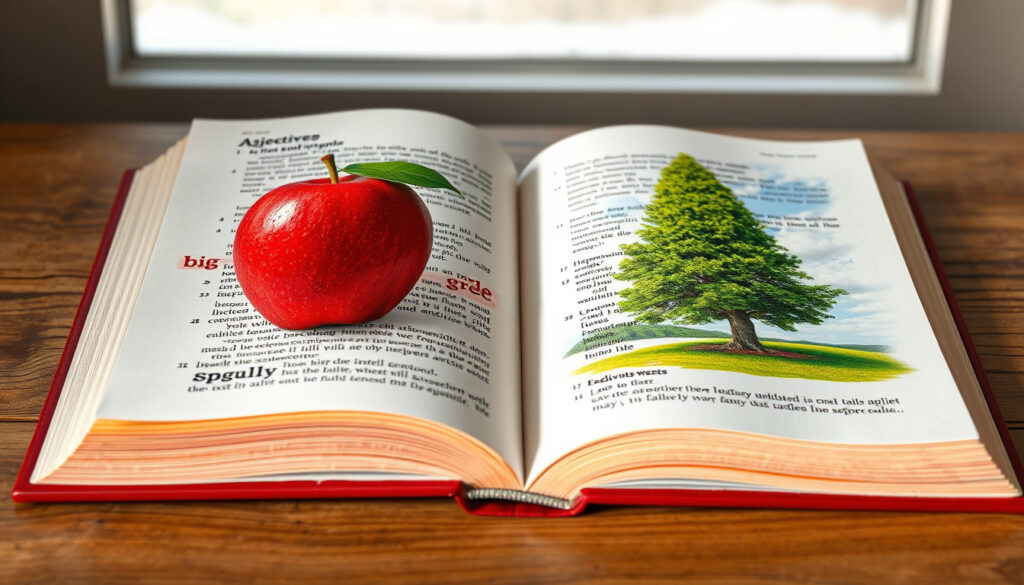
What Is an Adjective – Essential Grammar Guide with Examples
An adjective is a word that describes or modifies a noun or pronoun, adding details such as color, size, shape, or opinion to make sentences more vivid and informative. Understanding what an adjective is forms a foundational part of English grammar, helping young learners and adults alike craft clearer, more expressive communication. This guide explains adjective definitions, provides examples across different contexts, and offers practical insights for teaching and learning this essential part of speech.
Adjectives appear throughout everyday language, from simple descriptions like “blue sky” to more complex expressions like “the cheerful, energetic puppy.” According to Twinkl’s teaching resources, adjectives help create vivid images about people, places, or things by telling readers what something looks, feels, tastes, sounds, or smells like. Grammar Monster confirms that these words fundamentally change how we perceive the nouns they modify, adding layers of meaning that enrich communication.
Whether you are a parent supporting home learning, a teacher preparing grammar lessons, or a student exploring English language basics, this article covers everything you need to know about adjectives—from basic definitions to advanced usage patterns.
What Is an Adjective in Grammar?
In grammatical terms, an adjective is a part of speech that modifies or describes a noun or pronoun. Merriam-Webster defines an adjective as “a word that modifies a noun,” though it also notes that adjectives can “add details to a noun or noun phrase to make it more specific.” This modifying function means that adjectives tell us more about the properties, qualities, or characteristics of the things around us. SplashLearn’s educational guide emphasizes that adjectives serve as descriptive tools, helping readers visualize and understand subjects more completely.
Adjectives can appear before nouns (as in “big house”) or after linking verbs like “be” or “seem” (as in “the house is big”). Both positions are grammatically correct, though the placement often depends on the specific sentence structure.
Quick Overview: Understanding Adjectives
A word that describes or modifies nouns and pronouns
Modifies qualities including size, color, shape, and opinion
Big, red, happy, fuzzy, tall, beautiful
Appears before or after the noun it describes
Key Insights About Adjectives
- Adjectives limit or specify nouns, making language more precise
- These words enhance clarity by adding descriptive details that help readers form mental images
- BBC Bitesize describes adjectives as words that “tell us more about nouns”
- Multiple adjectives can be used together in a single sentence, following specific ordering patterns
- Adjectives do not change form when describing plural nouns—you write “three black cats,” not “three blacks”
- The most common pattern places the adjective before the noun it modifies
Snapshot Facts About Adjectives
| Feature | Details |
|---|---|
| Part of Speech | Adjective |
| What It Modifies | Nouns and Pronouns |
| Primary Function | Describes qualities, characteristics, or quantities |
| Common Types | Descriptive, Quantitative, Possessive, Comparative |
| Typical Placement | Before noun or after linking verb |
| Educational Level | KS1 through KS2 (ages 5-11) |
| Form Changes | None for plural nouns |
What Is an Adjective Example?
Seeing adjectives in action helps cement understanding. According to Twinkl’s teaching wiki, adjectives can describe colors, sizes, textures, feelings, and countless other attributes. The British Council’s learning resources note that when multiple adjectives appear together, size adjectives typically come before color adjectives—a rule that helps sentences flow naturally.
What Is an Adjective in a Sentence?
When examining sentence structure, adjectives play a clear role. Consider these examples:
- “The happy dog wagged its tail” — “happy” describes the dog
- “I saw a white bird” — “white” describes the bird
- “She carried a large backpack” — “large” describes the backpack
Grammar Monster emphasizes that adjectives in sentences help readers visualize subjects more clearly, transforming vague references into specific, engaging descriptions.
Adjectives follow two main patterns: noun modifier (“tall building”) and predicate position (“The building is tall”). Both patterns are grammatically correct; the choice depends on the sentence’s flow and emphasis.
Common Categories of Adjectives
SplashLearn identifies several adjective categories that help organize how we describe the world. Color adjectives include red, blue, white, and pink. Size adjectives encompass big, small, large, tiny, massive, and petite. Feeling adjectives cover emotions like happy, sad, joyful, elated, and gloomy. Texture adjectives describe surfaces as fuzzy, shiny, smooth, or rough. Additional descriptive adjectives include tall, short, friendly, beautiful, and old.
What Is an Adjective for Kids?
Teaching adjectives to children requires accessible language and relatable examples. BBC Bitesize provides age-appropriate explanations suitable for Key Stage 1 learners, introducing adjectives as “describing words” that tell us more about nouns. This simplified approach helps young learners grasp the concept without getting bogged down in technical terminology. Twinkl’s educational resources offer similar kid-friendly explanations, using colorful examples and interactive activities to reinforce learning.
What Is an Adjective Year 1 / KS1?
At Year 1 and Key Stage 1 level, children typically encounter adjectives as simple describing words. According to educational standards, KS1 learners should be able to identify adjectives that describe size, color, and basic qualities. Simple adjective-plus-noun phrases like “big ball,” “red apple,” and “tall tower” form the foundation of this learning. Teachers often use visual aids, story books, and hands-on activities to reinforce these concepts with young students.
Encourage children to spot adjectives in picture books during reading time. Ask them to point out “describing words” that tell them more about characters, objects, or settings. This visual approach builds recognition before formal grammar instruction begins.
What Is an Adjective Year 2 / KS2?
As children progress to Year 2 and Key Stage 2, their understanding of adjectives deepens considerably. Twinkl’s teaching resources indicate that KS2 learners should recognize and use more sophisticated adjective types, including comparative and superlative forms. At this stage, children learn that adjectives can compare things: “bigger” and “biggest” show degrees of comparison. Grammarly confirms that comparative adjectives often end in “-er” while superlative adjectives typically end in “-est.”
Types of Adjectives for Advanced Learners
Beyond basic descriptive adjectives, older students encounter several specialized types. Comparative adjectives compare two nouns, such as “Summer is hotter than winter.” Superlative adjectives express the highest or best quality, as in “She is the best football player on her team.” Possessive adjectives show ownership and include my, your, his, her, its, our, and their. Numeral adjectives describe quantity or number, either cardinal (one, two, three) or ordinal (first, second, third). Understanding these distinctions helps students use adjectives with increasing precision.
When combining multiple adjectives, remember that size typically precedes color: “a big blue umbrella” sounds more natural than “a blue big umbrella.” This ordering rule applies consistently in English, making descriptions flow more smoothly for readers.
Adjectives in English Grammar Context
Understanding adjectives requires seeing them within the broader context of English grammar. Adjectives work alongside other parts of speech—nouns, verbs, adverbs—to construct meaningful sentences. When an adjective modifies a noun, it creates a more specific noun phrase that provides readers with additional information. The British Council’s grammar resources emphasize that adjectives are essential for descriptive writing, offering vital details that help readers visualize and understand subjects more completely.
Educational progression typically introduces adjectives in early primary years, then builds complexity through secondary levels. Year 1 students learn basic color and size adjectives. Year 2 students add comparative forms. Key Stage 2 brings superlatives and possessive adjectives. This structured approach ensures students develop robust grammatical foundations that support advanced writing and communication skills later in their academic careers.
What Sources Say About Adjectives
Multiple authoritative sources confirm the definition and function of adjectives in English grammar.
“Adjectives are words that tell us more about nouns. They describe nouns.” — BBC Bitesize
“An adjective adds details to a noun or noun phrase to make it more specific.” — Merriam-Webster Dictionary
“Adjectives describe nouns and pronouns by giving attributes such as size, color, or other qualities.” — Grammarly Blog
Remember that adjectives describe nouns but do not change form for plurals. You write “My brothers are tall” and “We’ve got three black cats,” not “shorts” or “blacks.”
Summary
An adjective is a word that describes or modifies a noun or pronoun, adding vivid details that help readers understand subjects more completely. These describing words appear before or after nouns, following patterns that become natural with practice. From basic color and size adjectives in KS1 to comparative and superlative forms in KS2, children build increasingly sophisticated understanding of how adjectives function in English. Understanding this part of speech is essential for clear communication, descriptive writing, and grammatical literacy. For related language exploration, see What Is the Most Spoken Language in the World and Common English Grammar Mistakes to Avoid.
Frequently Asked Questions
What is an adjective in simple terms?
An adjective is a word that describes or tells us more about a noun. It answers questions like what kind, which one, or how many.
Where does an adjective go in a sentence?
Adjectives typically appear before the noun they modify (a red ball) or after linking verbs like “be” (the ball is red).
What is the difference between comparative and superlative adjectives?
Comparative adjectives compare two things (bigger), while superlative adjectives express the highest degree (biggest).
Do adjectives change form for plural nouns?
No. Adjectives remain unchanged when describing plural nouns. You write “three happy children,” not “three happies.”
What are possessive adjectives?
Possessive adjectives show ownership: my, your, his, her, its, our, and their. They modify nouns without changing form.
How many adjectives can be used together?
Multiple adjectives can be combined, but size typically comes before color, and opinion before size. Example: “a lovely big blue house.”
What is an adjective for Year 1 students?
At Year 1 level, adjectives are introduced as “describing words” covering basic attributes like color, size, and simple qualities.
Can adjectives describe pronouns?
Yes. While less common, adjectives can follow linking verbs to describe pronoun subjects: “She became nervous” or “They seemed happy.”
More related posts
 Ian Wright Net Worth 2025: How Rich Is the Arsenal Icon?
 DNA Test Ireland: Cost, Accuracy & Legal Guide
 Cast of The Crow: 1994, 2024 Remake, Controversies & More
 Tesco Mobile Phone Deals – Best Plans Prices and Perks
 Marilyn Monroe Death: Uncovering the Truth
 Diane Lane’s Relationships, Career & Personal Life
 Best Robot Lawn Mower UK 2026: Reviews and Buying Guide